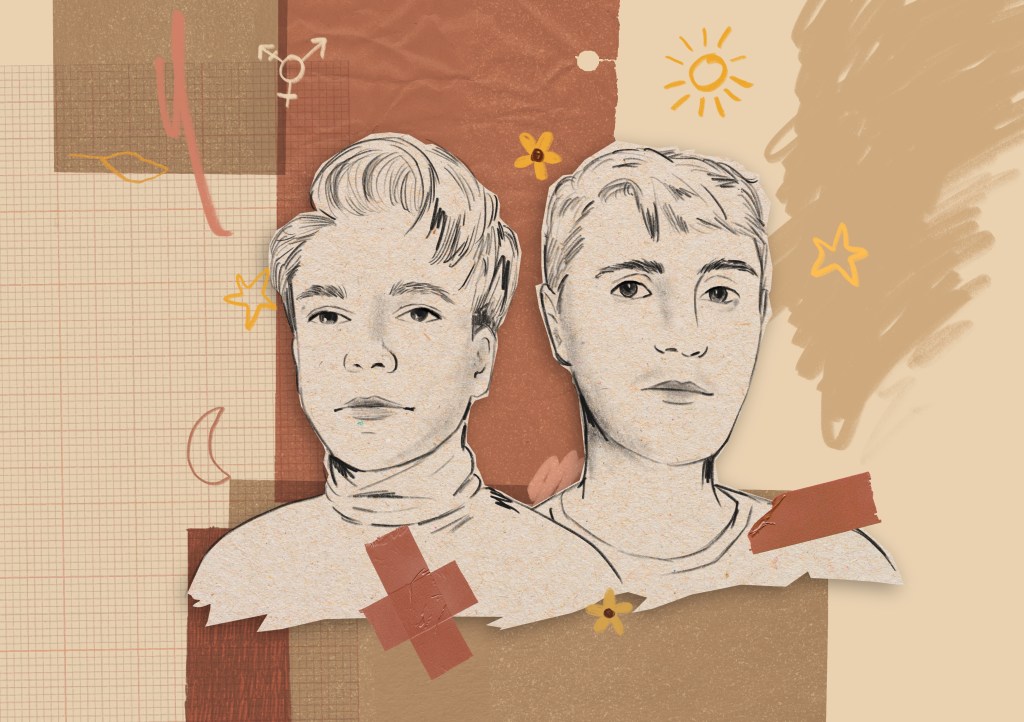
[upbeat drum based song]
INDIGO: Hello, hello, hello, everyone and welcome to Changing The Frame. We are your hosts: My name is Indigo Korres and my pronouns are she and her.
LEO: I am Leo Torre and I use he/they pronouns. We are a podcast that discusses trans non binary experiences in the film industries. every episode will count with the appearance of trans and/or non-binary multimedia artists in the film industries to talk about their work. We’re really excited to share these amazing talks and discussions with you all.
INDIGO: Today we have two amazing special guests, Ivor McCaskill and Rosanna Cade, incredible queer artists based in Glasgow, and the focus of discussion will be around their most recent work, which is called The Making of Pinocchio. And it is a recording of the play that they have been working on for four years now. During the pandemic, they recorded the play at Tramway in Glasgow, and it is honestly incredible. They’re also performing the play of The Making of Pinocchio in Glasgow on the 27th and 28th of October. So please make sure to check it out.
[upbeat drum based song]
LEO: This is changing the frame.
[upbeat drum based song fades]
INDIGO: Thank you for joining us today, Ivor and Rosana. I’m really, really excited because I met us at SQIFF and it was a great film that you just showed at the festival and I really enjoyed it. First I would just like you to introduce yourselves and what you do.
IVOR: You go first!
ROSANA: Okay, yeah. Hi, I am Rosana, Rosana Cade, pronouns are they/them and I am an artist based in Glasgow, my practice is sort of mainly rooted in live performance. And that’s sort of what my background and my training is in, but I feel like, yeah, that’s sort of really broadened out recently in the form of the work tends to sort of emerge in relation to whatever process or contexts I’m working with. Yeah, and I myself and Ivor collaborate as Cade & MacAskill, but I also have my own practice as well.
IVOR: Okay, hi, I’m Ivor. My pronouns are he/him or they/them. And yeah, I’m also an artist, making theatre and live art and I make work for children as well. And, and yeah, work with Rosana. That’s me.
LEO: So I was also at SQIFF and I saw the film, and it was really a big moment for me, because I come from Aberdeen and there was like, no cultural stuff in there. But anyways, you know, how you mentioned in Presenting Ourselves the way that you meet and how your relationship has developed and everything? And all of the practice and different stuff that you guys have done together? How has your practice developed, as like, through the years?
IVOR: That’s a good question. Have you got an answer Rosana?
ROSANA: Well, it’s… Me and Ivor have known each other sort of since I first moved to Glasgow, which is nearly 15 years ago. You can probably tell I’m not from here, grew up in the South of England. So we’ve known each other… I was a student on the Contemporary Performance Course, at the RCS. And Ivor sometimes did some guest lecturing on that course, and was sort of part of that community at that time. And then, after I graduated, Ivor invited me to make a show together with him, which was for Glasgay Festival, that used to be like, gay, mainly festival in Glasgow, obviously… And to make a show about lesbian history, or the sort of lack of it, and it was called Strange Hungers. And it was this kind of grubby, like, cabaret piece where we were finding the kind of small things you can find out about, like queer women from throughout history, and that’s how we started working together. And that was before we became partners in life.
But I think we just really got on working together and, I think, had quite a natural chemistry on stage. And I think one of the main things is I just find Ivor very funny, so I really enjoy making work with him. But then, and then, when we… Sorry I am just gonna give the whole answer to this…
[overlap of encouraging sentences from the rest]
IVOR: That was my first mistake.
ROSANA: We then sort of, we got together at the end of 2013 as partners and… But we found that we were… Because with both working separately, we actually were often away, we didn’t spend that much time together. So we sort of started making work together almost in order to be together more. And for a long time, our practice was just the work we did together was just in our band, which is called Double Pussy Clit Fuck. And we, and that was just a kind of something we did for fun and for love. And it was about like, it was quite punk, and it’s an anti-genre riot-Girl-on-Girl-and-boy-on-boy, experimental live up concept band. But yeah, and then, and then, in 2017, we started, that’s when we were… Yeah, we got a commission to make more of a show together. And that sort of… Since then, we’ve been working together a lot more regularly and making bigger pieces. For now, for the past four years, we’ve been making our show The Making of Pinocchio, which you saw the digital version of. I feel like we sort of establish more of a practice together of making shows and I suppose in some ways, just finding ways of expressing our lives and the changes that have been going on for us through different mediums.
INDIGO: By the way, I loved the name of the band, how did you come up with that name?
IVOR: I am not sure we, the band came out of… we were invited to create something for a night that was on at the Citizens Theatre in Glasgow, and it was a night sort of celebrating the idea of ‘Riot Girl’. And so that’s where we were like, “oh, we should try and be a riot girl band, how hard can it be?” That’s the whole point is just get some small instruments and then do it. But I don’t totally remember how we came up with the name.
ROSANA: I think you came up with it. We were looking at lots of riot girl names. And we really enjoyed sort of very sexually explicit ones. But I think what’s funny about that name is it’s also Double Pussy Clit Fuck sounds a bit like, you know, this awful lesbian porn created for like straight men. And I think, yeah, it’s certainly the sort of way we present ourselves on stage and our gender expressions, like very sort of against that as well in the acts that we do so. Yeah, it’s, we, you know, if people ever Google that name, they find, yeah, it’s probably just not a good idea. Actually, it’s just not a good idea. Don’t Google us?
[laughing]
INDIGO: I was gonna ask, because you’ve been making queer art together for a long time. And after you’ve both transitioned, I know that you’ve always played with gender, especially in Double Pussy Clit Fuck, in many ways that you talked about in Presenting Ourselves. How has your arts practice changed, and been reshaped by being trans, rather than before, when you’re exploring queerness?
IVOR: Yeah, I think… I think for me, I realised that making performance work has definitely been a way of processing what’s going on for me in terms of… Often gender but other things like “how am I existing in the world? How am I relating to other people? What’s important to me?”. And so it just feels like that’s a way to work things out, so it can be a really useful thing. Hopefully, there’s, there are other outputs that are useful for other people, or at least interesting. But the process is definitely an important part of it. And I guess, with this, this recent time of working, where we’ve been looking more particularly about transitioning, there was definitely a sense of “let’s start just with the creative response to it not thinking about what if there’s a show or if there’s a film or anything”. But you know, we’ve got a lot to process individually and together as a couple, as collaborators, so let’s use our creative juices to, kind of, to work through that. And then that kind of turned into like, “well, yes, maybe there is a show here or, or film work”. So I guess it felt quite… part of it feels quite organic. Like of course we would start working creatively as another way of coming at it.
> I guess, for me working through things, my gender, I’m like, “I need as many ways to think about this as possible”. And as we state in the show, there’s not very many models out there of like, “oh, this is what you do”. I think when I started to explore what I might be able to do to transition, I was sure there was going to be at least one website where you just type the stuff in, and then it’s like, “this is what you do. Here are the processes. This is where you should go”. But it really felt like, well, you’ve got to cobble this together from a lot of different places. Hopefully, it’s a bit better now. But I’m not sure. So you’re trying to cobble together your identity through lots of different ways. And so responding to creatively was one part of that, I think. What do you think, Rosana?
ROSANA: Yeah, no, I agree. And I think, I think as a queer artist, sort of… I feel like I definitely identify with being a queer artist. And I feel like there’s different strands to that. And I think on the one hand, it’s about creating work or spaces for other queer people so that we can see ourselves represented and learn and feel affirmed, and celebrated. And yeah, discover more about who we are and who we can be. And then I think the other side of it is about trying to reach outside of that community and help spread to kind of greater understanding. And sometimes a piece of work could be doing both of those things. But I think sometimes they’re different intentions. But I think sort of, yeah, I think it for me, it has… a lot of it has been about sort of a lack of representation as well that I have felt as a human growing up. So first of all, yeah, just sort of growing up with no… under Section 28 in the UK and in a small town, just like absolutely no rep, like didn’t know anything about any queer people ever in the world until I was like 19. And really, that felt like something to really reflect on and that I really wanted to be trying to overcome. And then I think when Ivor was first exploring his gender, again, I was just like, “hang on, like, there’s so few representations of like, couples going through transition in a way that is actually like queer and expensive and experimental”, because it’s so often just this really kind of normative presentation of that happening. Someone was like, “oh, there’s this, you know, BBC Four, play about this lesbian couple and one of them transitions”, but like, they’re just arguing the whole way through this play. This is awful! Like, this isn’t our relationship! And, you know, there’s, obviously lots of different kinds of representation are important and one thing can’t do everything. But I think it’s sort of… Yeah, feeling like… I suppose I’ve always felt this drive to yet be trying to present other kinds of options and, as Ivor says, to discover more through going on those processes together.
> I think as well, like, what a big learning process that’s happened for me over the past few years, since Ivor first started exploring his gender is just this realisation that things can really fundamentally change. things that you felt were very fixed and a very huge part of who you are can shift. And that’s, I think, in terms of being an artist, that’s a really useful thing to be working with, as well, like the idea of being unfixed and of, of trying to, yeah, always kind of leaves the door open for new ideas or things to be coming in. And I think, obviously, we’ve all just lived through this pandemic as well, which has been so awful in so many ways, but something it has shown us is that how unpredictable things can be and things can change a lot. And I suppose we’re always trying to learn to live with that kind of adaptability. And yeah, I feel like it’s sort of ongoing learning as an artist how to work with those things as well.
IVOR: And I think that it just makes me think, that can also be… It’s hard to hold on to that fluidity when you’re trying to make a career in the arts as well. Because you, understandably, get kind of… you can get pigeonholed, or you can pigeonhole yourself, I guess and say, “Yes, I’m the artist who talks about this thing” or you’re definitely gonna get a response about transness in this work. And so there’s a bit of a danger there, I guess. Yeah. So I think you’re right Rosana, like holding on to that flexibility and fluidity, can be really important for your own mental health and for your career as well, I guess.
LEO: I was just about to ask about your temporalities and your art. So like, You’ve almost already responded to the whole thing, which is very good. But thinking about fluidity towards the future, and in regards to your practice is one thing and thinking about it in terms of your like, your own identity… Do you guys ever go back and reflect on the people you used to be and the stuff that you used to do? And do you like have any feelings towards it and how you have shifted now, because something that you have made in the past, you might have like, started, and then it takes a few years to finish a project, and then you’re a totally different person? How do you feel about that?
IVOR: Yeah, I think… I think that’s a really good point. I think it’s something we’ve been aware of. Yeah, like with, with this project, The Making of Pinocchio started about four years ago. And it’s, we’ve, because we’ve been aware that we might be performing this show, I guess, I guess that’s something when you’re performing work, rather than it being a film piece that is, is done, maybe there’s a sense of like, “okay, is how’s it going to feel to perform this? And to say these words that maybe I wrote four years ago? Or maybe they’re, yeah, from you being a different person?”. And that’s, I guess that’s an ongoing question of, “is the voice of that person useful now? Or how can I frame it so that I can sit beside that voice?”. I think one of the things we were playing with, as we were making this was, we recorded each other, answering questions at the beginning with an idea that maybe in the work, there would be a conversation between that earlier part of ourselves and and the now. And that sort of fell away, maybe because it was quite hard, because I think some of those earlier videos, it’s like, really, it can be… it’s really difficult. I think some of the time I’m quite upset, I’m thinking about “I don’t know what I’m doing, I haven’t started transitioning, it feels really big and hard to understand”. And the time of doing the performance seems so far away. But I think the idea of yes, considering yourself and talking to yourself as a past version, and how do you hold those past versions, I think is kind of there within the work.
> But it’s… Yeah, it’s complicated. And I think also in a kind of, like, newer queer time-space, I find time as… because I was a bit late to this I find time very difficult and confusing. And if I look at the things, I’ve been trying to sort out some stuff in my room. And like some of them, like… what are the photos that I have kept or like photos of me doing…? I played Kenickie in our school show when I was like 15. And I don’t really understand how this happened, where the teachers were like, “Yes, you are the most masculine person in the, in the drama group, so you as a female presenting person should be playing this very masculine role”. But I’m like, okay, there was something in me there that knew that I wanted to be on stage being a guy, singing Greased Lightnin’ or something. So I can get very caught up in it, I think is what is my answer. So I have to be a bit careful about not going, not going back too much. But one thing I was thinking was when we were talking about Strange Hungers this, this lesbian show that we made… Yeah, it was a lesbian show. And the idea with with that was definitely like we want to have a representation of queerness and the female masculinity and lesbian identities that doesn’t end in drama, that is fun, that is upbeat. And I think there’s a similar sense in the new work that we’re making around transness, is that thing of “there’s so much drama or the hard stuff is, is there and can we offer a different option?”. So I suppose there is something about like, these things repeating themselves within your life with different parts of your identity.
ROSANA: Yeah! I think, yeah… It’s interesting this question… It’s making me think a bit about the difference between film and live performance as well. And obviously, this is largely a podcast to talk about filmmaking and we feel very happy to be here talking. For us it’s sort of… We have made these digital pieces now. And I’ve made another film that was at SQIFF a couple of years ago called Walking:Holding, which is about another one of my projects. So it is a form that we’re working in. But we slightly feel like imposters, I suppose, putting… It’s like when we’re in the band, and then the band happens in a band festival. And we’re like, “Oh, we’ve actually just performance makers”. But that’s, I think that’s having more of a queer flexible approach to practice. Anyway, what was I saying? Yes, but like, film, I think something that I have sort of learned to overcome, that I really struggled with when I was first making my Walking:Holding film, is this feeling of like, “oh, yeah, like, then it’s going to be fixed, and that’s going to be the thing, and then that will always be the thing”. And that it will be the decisions you made at that moment of time series of decisions. And then there it is. And then people are going to keep watching that version. Whereas with live performance, I feel like, yeah, the process is just very different to also with film, you know, as working with the filmmaker, and then from the beginning, they were very much like, “do you have an idea of what you want the film to look like?” And all of this, and I’m like, “How can we know because we haven’t gone on the process yet?”. Whereas with performance, I feel like all of that emerges sort of during the process, but with low performance, you can change it in the moment of performing it, you can change it right up to the last minute. And perhaps there is, in some ways, inability for it to have that, that fluidity within it. And I think we were interested in trying to have some of that with The Making of Pinocchio, because yeah, I think with making autobiographical work, sometimes there isn’t space for that reality that we are constantly changing and shifting. And, you know, I’ll probably say things today, and then by the time this podcast goes out, I’ll be like, “No, I don’t agree with that anymore. I feel differently about that”. So um, but I think we also all understand that to an extent as well, and that that is a truth of that moment, or that to that person was in that moment when we’re watching a film and and it’s interesting to have those kind of, yeah, things to look back on and reflect and notice growth or change, as well. But I think it is something that at first I found it, yeah, a bit difficult to sort of come to terms with in terms of working in that medium.
INDIGO: Yeah, that’s… that’s very interesting to hear about it. I mean, we’re a filmmaking podcast, but you can talk about anything you like. I feel like queer people just dip their toes into like loads of different types of art and loads of mediums. So it’s really good to hear about other perspectives. And I would love to watch The Making of Pinocchio live, by the way, it would be incredible. My question is, why did you choose Pinocchio specifically, to adapt and discuss your trans story?
IVOR: Well, Pinocchio chose us. The idea of Pinocchio came up when we were making another show earlier, that we started working on in 2017, I think. And we were exploring ideas around good and evil, and morality. And because I make work for children as well, there’s often a sense of like, “what is it that we’re telling children about the world? And how does that tell us what we’re telling ourselves about the world?” So I’m often quite connected with things that might seem a bit childish, or, like in that kind of children’s world. And for some reason, while we were exploring good and evil, I got onto this idea of like, “oh, there’s Pinocchio who’s having to prove himself to be good in order to get what he wants” and the idea of being a real boy, but it took me quite a long time to go, “oh, why am I identifying with someone who wants to be a real boy?”. The cogs in my brain go very, very slowly. And so this had come up, and it took a while to put that in as, in as a sort of puzzle piece of like, “oh, maybe there’s something about my gender”. Can you remember, Rosana?
ROSANA: I mean it’s quite funny that comeback because we were making this other show and really, it was called, it was called MOOT MOOT. And we’d sort of decided we wanted to be these like, sort of talk show hosts, and we were great, we were certain to work with them. But then Ivor kept talking about Pinocchio and I was like, “I’m just not really understanding where this Pinocchio thing’s coming from…”. And then just like it sort of made sense to have a look at it. But then I remember we did a really weird sharing where we were doing this radio thing back and forth. And then at one point, you just skipped around in a circle holding an apple like Pinocchio. But that was, you know, it was, it was really funny and interesting at the end of that year when you were sort of like, starting to look at your gender. And then it was like, “oh, Pinocchio wants to be a real boy”. So I think, yeah, then it was sort of in the air. And then at the beginning of making that project, we as I said, earlier, we just, we weren’t committing to making a show, we thought we were really lucky to get the Diana tour bursary. And that gave us a bit of time, we said, we just wanted to be able to work together creatively to respond to some of the changes that were happening, without necessarily needing to commit to a fixed outcome.
> But quite early on, we were sort of thinking about Pinocchio again, and I think it just felt like… I mean, our main reference point is the Disney version of Pinocchio as well, more than the original stories, but we did look at them sort of through it. But it felt like you know, something we could really manipulate for our own use. And it’s sort of full of quite interesting ideas, or images that, like, there’s lots of transformations that happen within it kind of boys turning into donkeys, and there’s a cricket and there’s, you know, a fairy, and it felt like, quite quickly, we could sort of see how those could fit into the trans narrative. But I think, as well, you know, this fixation, this idea of being real felt like something that was really important for us to explore, and what that means from a trans perspective. And yeah, like, I suppose we’d sort of came up with these questions quite early on, which is like, “are we trying to mould ourselves into existing categories in order to be seen as real? Or are we like trying to create new categories and ask that they be seen as real or legitimate? Or are we just trying to sort of somehow subvert the idea of any, like identity being real? And, you know, drawing that distinction between real and not real?”. So those are the sorts of questions we were working with. And I think then, it allowed us to explore that within the form of the work as well, if we were interested to think about like, obviously, Pinocchio is this kind of fantasy tale. And yeah, it’s sort of the importance of fantasy within queer world making, yeah, the ability to sort of be able to imagine how things could be differently. And so it gave us these, these useful sort of dualities to explore like, the fantasy and the real or, yeah, like the authentic and who gets to decide where those lines are drawn, and actually gave us a space to have a lot of fun, I suppose blurring a lot of those lines. Yeah, and I think also, because we were making this through the time, you know, of, whilst we were both sort of going on our own journeys, there was a lot of stuff that was quite tender and difficult at times. And actually, using Pinocchio allowed us to just have one step of distance like this doesn’t need to be all just about us. This can be, we can use Pinocchio to make something that is slightly broader. And, yeah, allows us to like pretend to be people that aren’t us as well, which is always fun
LEO: See how you’ve done like, so many different things both together and separately, and you’ve done performance art, live art, filmmaking, self documentary, and so many different types of like, storytelling. How do you go about picking the storytelling? And would you consider different new ones that you’ve not tried yet in the future?
IVOR: Yeah, I think… I think within each process, there’s usually a question around the content and the forum and how those are going to interact with each other or give you more jumping off points. So I think, yeah, always…. There’s always options for how, how the form is going to change the pieces. So I think… Or there’s always someone giving you a form or a context to work in. But yeah, there’s always the question of “what is this going to be? How is the audience going to interact with it?”. And I guess, with that, at the heart of it, there has to be a question of what’s going to be the most interesting thing. Or would it be surprising that someone encounters this in the streets? Or if they’re viewing it in their home? What does that mean compared to them viewing it in a theatre? Or is it a one on one piece? Is it like for lots of people at once? And I think those, it just gives you a whole other palette of, of interest to kind of get, get stuck in with and I think, maybe, for me anyway, like keeping it interesting. And keeping there being novelty is really important. And so yeah, I think, definitely interested in other forms and ways to create the work. But with this idea of there’s… there’s a performer and there’s an audience who are having this relationship as a live moment, even if it’s mediated for them or they’re watching it 10 years down the line. So. So yeah, I think that’s yes, we would consider this service.
ROSANA: Yeah, no, no, I agree. And I think, I think sometimes it’s hard to explain what we do or what our practices, but I think, at its heart is sort of experimentation with form. And, and that’s, like part of the practices, discovering what the, what medium or what form a project needs in order to be realised in a way that’s going to serve it. And, and perhaps offer a new way of experiencing or looking at that particular kind of inquiry? And I think, yeah, maybe that’s why I would say we’re like experimental artists, rather than perhaps more traditional artists who might always kind of have a form that they use, like, I’m a playwright, and I write obviously, people are very experimental within playwriting. But for us, in some ways, it’s hard because at the beginning of a project, you’re like, oh, we have nothing, because what do we do, but then, you know, it like can sort of develop itself through that way. And sometimes it doesn’t even feel like it’s necessarily storytelling, like, actually, some of my own work, is, I make quite a lot of one on one performance work, like I have a piece called Walking:Holding, that I made 10 years ago, but it’s still touring. And that’s for one person at a time, and you go on a walk through the city, and you hold hands with a series of different people, one after the other. And the people in it are like local participant performers, who are all kind of different to each other in terms of like, age, ethnicity, gender, sexuality, and it’s about exploring your city from someone else’s perspective. So I think, as Ivor says, it’s often like, what what is the experience that we can give an audience and I think when I’m working in live performance, I get excited thinking that this is like an opportunity for an actual experience that you might not have otherwise. And I think live performance can give people, yeah, the chance to kind of step outside of the boundaries that they maybe normally act within, obviously, in a safe and consensual way that can really open things up for people and I think help people to understand other people’s perspectives, or just feel like some sense of freedom or liberation that they might not have experienced in some instances, as well. But yeah, and I think I think The Making of Pinocchio is is a bit different to that. It’s definitely like, obviously, in the digital form and in the live piece, we’re making it you know, it’s a show, and people are going to come and sit and watch. And I think what’s really interested in, in terms of the form of the live show that we’re now making is, it is so hugely and fundamentally influenced by the fact that we made a digital piece, as a main part of the process. We were already before we knew we had to do it as a digital work, we were experimenting with using a camera in a live feed, and we were using, like, as you’ve seen it, we use a lot of forced perspective within it. And I think with that we were thinking about like, because one of the things we’re exploring is the idea of the real versus the kind of fake or the fantasy, what are the techniques that we use in theatre and in film to make things seem real, that aren’t real so and we had a lot of fun playing with that, like we do mime and all these things that we would never normally do in a way as well. And forced perspective. So yeah, that’s sort of an example of how those ways of creating material came from the questions that we had. But now that live experience is going to be something that’s really the whole time, you’ll both be watching what’s happening on this big screen that’ll be near the front, as well as seeing us in the real space, making it so you’ll see always two perspectives on the same action, which I think is going to be quite exciting, actually. And hopefully not just too overwhelming for people to look at. There’s going to be a lot going on.
INDIGO: I’m so so excited to watch this performance live. And I know that you play with loads of different genres and stuff. And I’ve noticed that in both the films that I have seen, you show your naked bodies. So and I think because Presenting Ourselves I think Ivor was saying that if I’m on stage, it is likely some or all of my body will be revealed at some point. So what was the reasoning behind that? Why do you think that’s so important to to enter queer performance? Or filmmaking?
IVOR: Yes, I did say that, didn’t I? And now everyone can hear it forever and ever. Did you have an idea, Rosana?
ROSANA: No, I think it’s, it’s interesting this question. And I think I think as like a younger maker, I was very drawn towards… Yeah, having some representation of nudity on stage, and I think it was to do with the… Again, this these questions of representation, and are we seeing bodies that are queer and different? And at the same time, you know, it’s important to talk about our privilege, like we’re both white people and, you know, slim and so there’s like, also some privileges that we have around, around that, and we’re not like, yeah, you can only represent who you are, I suppose. But I think that, yeah, it was a sense of like, because probably as a teenager, I’d felt very, like I had a really did feel like I had to conform to a certain way that a woman should look and felt all this anxiety around body hair, and yeah, and the size of my body and all these things, it just as I was discovering, like, a queer identity, it just felt really important to me to be like, and here it is. And I suppose in some ways, for me, that was about… Yeah, like owning this body that isn’t conforming to that way that, that it that I’d been led to believe that it should be. And I think, I think that becomes even more important in some ways, in terms of showing trans bodies, but I also really don’t think that it should always be a necessity at all. And I think it’s really down to the individual. Because, you know, I think there’s really complicated questions around sort of what affects, obviously in a bigger scale, what effect trans visibility is having, when we, you know, we know that there’s, obviously we’re living in a time where there’s quite a big transphobic backlash, but also this obsession with like, trans genitalia and what’s going on. And, and so it’s sort of like, I think it’s really complicated that decision of when you choose to show yourself and what the space is, and what the context is around that. And it’s something that we, you know, we do speak about, but I think it felt important for you Ivor in The Making of Pinocchio, to do it, but I think within that we’re also… It’s as much about showing that as it is about questioning, like the, the frame through which we view those bodies, and this sort of questioning the viewer, in terms of how they’re looking at that and who they are to be looking at that and why they’ve come to see that kind of… this kind of work. And yeah, so I think yeah, hopefully within it were sort of, as well as presenting it, we are asking some of those questions about how we, how we view trans bodies in different spaces.
IVOR: Yeah, I think it is something that I found earlier on as a quite a freeing thing to do in performance. And it has something to do with the discomfort that I might have been feeling wearing certain clothes, or having clothes that maybe aren’t fitting quite right or the way you want them to. And, and even when you’re making performances, it’s always, for me, it’s always a bit of a stress of like, Oh, what am I going to wear? How am I going to look like me? Or how am I going to..? what’s the best thing..? unless you’ve got a really clear costume idea. So sometimes it’s really like, just take those clothes off, and then we don’t have to worry about how the clothes are going to fit. And when I was identifying as female, I had very large breasts as well. Well, I mean, to me, they were, like enormous, they probably weren’t quite that big, but they were quite large. And so sometimes it would be quite a big deal to be completely naked. And I have this fiery bush as well that’s, you know, quite an impressive image and because you’re in the business of making images and scenarios and things. Yeah, often the body is quite a useful tool to do that. And, but yeah, with all the caveats that Roseanne is talking about in terms of, do you feel you have to do that? Or what is that currency that you’re then using? So I think it can be both this powerful and empowering thing, but also a little bit, it can be problematic in terms of who’s watching it, but I guess when it’s when it feels like it’s in a space, that is for friends, allies, as much as as much as it can be, it can feel like a kind of gift of generosity in a way of going well, here I am. And this is what I’m talking about. And yeah, as, as you were saying, there’s sort of this obsession with like, what’s going on under your clothes as a trans person? What’s going on in your pants? And the… There’s a freedom and going well, this is what’s going on in my pants: is absolutely none of your business. But if you’re also, if you’re interested, that’s fine, because I think the it takes away the mystique of yeah, what… What are these strange trans people hiding away? And to sort of see these these bodies who have different parts that might be associated with different people all put together I kind of find thrilling in a way that that I am happy to share with people if it’s on my own terms. Yeah, but it is a complicated thing. But I think, yeah, in this, as I talk about in Presenting Ourselves, and in Pinocchio, I hadn’t really realised that there was something that I needed in terms of being seen. So I’m playing with this feeling of, of course, there’s times I don’t want to be seen at all, I don’t want anyone to be looking at me. And I don’t want anyone to be thinking, what’s going on with him? But other times, I do need to be seen. So when we weren’t able to go out clubbing or be in queer spaces, there’s this miss… It’s like, there’s this misunderstanding. And I think I remember having a thing a lot, it’s sort of died down a bit, but a lot in my head going. You don’t know what’s going on with me. You don’t know what’s happening under these clothes, just as you’re walking down the street. And it’s this strange thing of like, why do I need you to know or just when I’m in a shop? Like, maybe I’m going to tell this person or when you’re being gendered in a certain way, like, as a transmasc person, what I found was, men have a lot of name words for each other when you’re interacting with them. Like you’re suddenly buddy, mate, pal, chief… like all these things, like, a chief. Let me take my clothes off. Yeah, that’s, that’s good enough for one. Yeah, this thing of, this is your body is your, your instrument within the performing arts, and it feels like it can be a useful, useful thing to be able to sort of show, show what you got. But you shouldn’t always have to do it.
ROSANA: I think I was remembering that there’s sort of some of the, in some of the process of The Making of Pinocchio, we were talking about this idea of like demystifying, as well, and it feels like sometimes in sort of cis imaginations, there’s so much going on when they think about trans people. And I suppose there is something in just being like, just like, don’t stop imagining, like, I’m not interested in all this mystery around what’s going on? Actually, in this moment. I’m just like, here I am. This is real. This is me. And I think that was sort of… Yeah, I remember you sort of talking about that a bit Ivor in that, that that’s something you felt that you wanted to do, but yeah, obviously, and you know, that’s just not obviously not everyone feels like that. And no one should have to do that at all as well. But it felt like the right thing in that moment, I suppose.
LEO: I feel like self presentation and the idea that we have about ourselves is very different from what other people have for us as well. Like Ivor you were saying like when other men regard you and they like give you all of these names and stuff and they’re reading you a certain way and everything. One of the things that struck me me a lot of seeing you guys at SQIFF and like hearing you talk at the panel was how you were speaking about how, after Ivor transitioning, now society reads you as like as cis-het couple at times. And I found that really interesting because obviously like seeing you guys in the setting that we were in, you were very totally queer to me. And I was like, I don’t I don’t understand how anybody could think this is a cishet couple? Like, I just don’t get it. And it’s also like, we have noticed that’s a bit of a recurring theme in your art to be like loudly queer about that. So would you care to like, delve into that a bit more?
ROSANA: It’s funny recently, I think you said it Ivor, where sometimes you feel like, maybe another gay person looks at us and they think, Oh, they’re both gay, but they don’t know. Like, they think we’re like a lesbian and a gay man in a relationship or I don’t know, like, you know, that is us just really imagining what other people think. Yeah, I guess. I don’t know, I often sort of thinking about like, gender identity. In general, I suppose it’s always this interplay in relation between how you feel, how you look how you think you look, and how other people see you, which is often something you’re only imagining, anyway, sometimes you get told whether you want to or not, but and so when you feel a slight mismatch there it you know, in some ways, that’s sometimes in the extreme, that’s a really, really, really horrible and uncomfortable situation. And sometimes it’s just a sort of slight jolt, and it can feel really different at different times. But I think, I suppose it’s, we, I suppose we talk about it a bit, because it sort of like shows in a way that like, lack of space and imagination that we still have within the categories that are there for identifying people. And obviously, you know, we know that these categories of like heterosexual and homosexual, trans and cis have been invented mainly by cis straight white men, I think, you know, back in the day, and then we’re all trying to, like, align ourselves in amongst them. And, and it’s sort of, yeah, it, then you find yourself in this space that, you know, that feels just like much more open and fluid. And obviously, now, within our queer communities, we have so many more words, you know, that we’ve sort of been coming up with, to describe, like, so many different ways of being and thinking about who you are, and your sexuality and your gender, but I think still kind of, there’s, yeah, I was gonna say, a lack of imagination. But I think that’s a harsh way of saying something that’s actually maybe like a lack of knowledge and of seeing different kinds of people to be able to read with more nuance who we might be and, you know, obviously, in some ways being read as heterosexual is a privilege and like, you know, you are therefore safer in the world. But I think, and yeah, there’s this, I think something that can feel difficult is this idea that that’s the aim and that we would be so happy now we can finally be this normal thing. And we can get a card that says auntie and uncle on it, which is you know, that you know, that that happened, like, and that someone in my family actually trying to be really accepting of Ivor’s transition, and like, oh, we see you in this way. But it’s like, oh, no, we’re not. We’re not that. And yeah, I guess. I’m trying to like put these things into words, but I just know for me there’s this like, physical sort of feeling of like, no, I’m a rebel. I don’t know, like that’s a part of my identity is that we’ve fought for for so long to sort of exist in a non normative way and, and really build ourselves up around that. But it even though it’s actually gaining some privilege, it can feel like a loss of something as well. Yeah, I don’t know. What do you think, Ivor?
IVOR: Yeah, I agree. I think the… Yeah. It’s just, it’s just speaking to like, complexity, isn’t it? It’s like that it shouldn’t feel like a trade off of like, oh, you discover more about your identity and you live more in your truth. Not even a truth but you’re living more as yourself and then something about that shifts, shifts how you’re being read and, and takes you away from that truth somehow. Like I think it just takes a lot of extra brain bandwidth to be able to hold all these different spaces and to stay, to stay true to yourself. Especially when you’re exploring it, when it’s not a singular truth, and you’re not totally sure about it, and you’re looking for clues as to which direction to go. You know, it’s being, I think, being a human and being queer and being trans. And is this, this detective journey of trying to get clues as much as you can? So like, oh, what happens if I wear this outfit? Or what happens if I stand this way? What kind of responses would that give me and so I was thinking of that, you know, the phrase, well, what other people think is none of your business. But of course, it is. Because you’re living in that reality of other people’s opinions. But as Rosana says, it’s, that’s often your projection of their projection onto you, which, that’s maybe none of your business. But yeah, and it’s also like this, don’t have anything against cishet people. But I think maybe one part of it is that some of my best friends are, but one part of it is the speed with which these changes happen in your brain doesn’t really have much time to kind of catch up with it, some of the the temporalities, within, transitioning can feel so long, but then other things happen very rapidly, and you’re catching, you’re playing catch up all the time. Like, I remember using my… my old name for myself, by mistake a lot or, you know, taking time to get used to the pronouns and our wiring is trying to, to deal with those things. So it’s, yeah, it can be surprising when you realise something about yourself is changing, and can be very exciting as well, I guess. And so yeah, I suppose in some ways, it’s, it can be affirming to be read in those ways. And that can feel that can feel awkward as well of like, oh, did I just want people to call me buddy, like, it’s something I’ve been really desiring.
ROSANA: I think, just You’re making me think a bit about like, I think that we try to live in a way where we aren’t trying to worry too much about what other people are thinking of us. And, you know, just to sort of work on our own confidence. But so I think the thing that’s hardest for me is when it’s like actually not being seen by other queer people, because I think it’s such a, it’s a really lovely part of being queer. I think that you, you know, if you’re just walking along the street, and you see some others, and you have a little, little smile, I didn’t know that, that just sort of, you know, you’re part of the secret club. And, and so sometimes, like, not having that recognition, which I think yeah, occasionally does happen depending on how we both presenting that sort of maybe I feel a slight loss around, but I also think, you know, obviously, Leo you were talking about, yeah, being at SQIFF, and I suppose how we feel in that space, and we’ve shown the film, and you’ve learned about us, and so we’re sitting there, so there’s like a lot of information about our identity, that’s there. But I’m always really interested in thinking about the different spaces that we inhabit, and how they affect how we’re seen and how we feel and how able we feel to be able to be ourselves, which I think we talk about in presenting ourselves. And then we’ve always throughout our relationship, gone on like little trips to the Scottish countryside. And there. Yeah, it’s just so different. And I it’s, it has really made me understand something of straight privilege, because we did used to, I know that there was just this like, edge of the brain fear of that we’re going to experience homophobia, like when we go to check into the hotel or when I know in these places where it feels way less diverse than being in the city. And if we were in a hotel that had like a swimming pool or whatever, you know, which we’re very lucky to be able to do. It would be me and Ivor, two quite tall, female looking people with like short hair, hairy armpits, wearing matching, like black swimming costumes that cover up most of your body and just like and then all these like couples have like a really feminine woman in a bikini and a man in trunks. I don’t know, like, in general that you know, you go to these places and suddenly you just basically see a lot of straight couples and the difference feels huge actually in those spaces. And then, yeah, it’s just that that… that feeling has sort of gone. And there’s a part of you that misses it. And there’s also a part that’s like, wow, like, yeah, it just is a lot easier, in some ways. Not that my body has really changed that much, but there’s just, yeah, I don’t know, it just I’ve really noticed that shift. And it’s like, oh, yeah, like, I don’t know. Definitely. When we were sort of presenting as two lesbians, I think we were… we were more visible. And actually, that felt difficult at times. Yeah, in a way that I can only notice more now that that isn’t happening so much. So there’s yeah, that’s that is like, yeah, a sort of side of it, where there’s definitely a privilege. That’s good to acknowledge as well.
INDIGO: Talking about queer spaces, and filmmaking, specifically, as queer artists yourself, in which ways do you think your way of exploring gender through filmmaking is different from other filmmakers in the business? And that could be queer or not queer filmmakers? I know that you’re talking about performance as well. So you can talk about any type of art here.
IVOR: I think in terms of filmmaking, the the main difference would be like we did, we did not know what we’re doing. Yeah, I don’t know. I think I think there is… If I think about the presenting ourselves piece that we made, I think there is something about kind of collage and using what we know how to do. So we, with that piece, we decided to kind of work separately and just be thinking about the same kind of ideas, and then bring it together. So I think that sort of collaging of different styles and different ideas, and then fitting them together, rather than having a sort of narrative arc or sort of documentary. But also, yeah, it’s not sort of telling that that’s straight to tale. Although I just haven’t seen enough work. So I’m not saying that that’s different from anyone else. And so don’t want someone to turn and go, that’s what everyone does. But I suppose yeah, those, if I think about the performance work we make, and the way we we approached, making that film is like pulling these different elements together different styles and seeing what happens when they kind of rub up against each other, which also feels like a queer approach in a way, or like a live art approach of like, you know, cherry picking what you want to try out and test out and give it just give it a go.
ROSANA: Yeah, I know, you started by saying, Oh, but what’s different is that we don’t know what we’re doing. But I guess I think that like, we… because our, most of our background and experiences in making performance, I think we we do come with a slightly different approach to making a film, which is what you’ve described, I think that, yeah, I think sometimes it can be really interesting when people come to forms that they aren’t necessarily trained in, because perhaps there’s new ways of thinking about how things can go together, or how things can be made. That sort of coming from somewhere intuitive, rather than: I’m taking this received way of how we do these things, perhaps. Not that I’m saying we’re doing anything particularly groundbreaking, but I was, I think, as well, in terms of, you know, what we’re interested in with exploring gender and presenting that I think we’re really interested in pleasure and in joy and in amusing the space that we have, and the platform that we have to be trying to without completely like shying away from the difficulties, but be really trying to create works that embody trans joy in some way, because it just feels really important, I think, to us to do that in a time when there is a lot of negative stuff happening in a lot of media avenues. And I suppose we’re interested in how can creating artwork be a space to imagine how things could be different? And within that, yes, I suppose focusing on sort of imagining new ways of being and that are concerned with pleasure and joy. And I think, yeah, it’s not trying to discount the struggle that exists. But it’s, you know, yeah, yeah, I think I’m just gonna repeat what I’ve already said. And there are other people that are doing that as well. But yeah, that’s definitely something we’re kind of interested in as artists, I think.
LEO: in a less abstract way a more like practical and physical way. How do you guys approach venues and crews to work with you, like, repeatedly work with some people and some spaces are like, do you try to switch it up? What happens in that sense?
IVOR: Well, I think I think in terms of, yeah, developing a practice within performance works as a lot of it is about creating connections with venues and presenters and you find you find the people who align with your work. And it’s often people who are presenting stuff that you’re really interested in. And I think that becomes clear of like, oh, the work is never going to be in this space, or it’s going to have to be a very particular context, if it’s in that space, like talking about the riot girl night that we did in the Citizen’s Theatre, it’s something would have to happen in quite an interesting way for our work to be usually programmed in the Citizen’s Theatre, but in that tiny room that only 50 People can fit into, you can go in that space. So there is sometimes there’s something about like, finding those more, there’s smaller and marginalised creative spaces. But I guess as we’ve done more and more work, there’s and there’s been more of a move of having more queer work taking up more space now that that those two things do seem to be coming together where we’ve we’re creating work that is in the main house of places, but it is, yeah, it’s building those relationships over time and kind of interest. So that’s sort of on the programming side. Would you say that’s right?
ROSANA: Yeah. Yeah, I think certainly when I was starting out, and when we were making Strange Hungers that was in The Arches, which I think, you know, was a really important venue in Scotland in terms of somewhere that was supporting and hosting queer experimental work and bringing big artists in. And I feel very lucky that when I was a sort of emerging artist that was there, because I think that really supported my growth. And I think, you know, that isn’t there so much now, but we have a good relationship with Tramway and Take Me Somewhere Festival who’ve been really supportive. And yeah, there’s other people like Fierce Festival in Birmingham, which is a brilliant performance festival, sort of, not complete. It’s queer led, and definitely has queer programmes, a lot of queer artists, and also the Malborough Brilliant Supporters of Queer Work based in Brighton so that we’ve sort of been really lucky to build relationships with those people across the UK. And also, there’s a venue in Hamburg called Camp Naugle, and they, yeah, that it’s also a space that really supports queer work. And the people that we have relationships with in most of those venues are also queer. And I think, in some ways that does feel important to us, supporting us to make a work like The Making of Pinocchio, because it it’s been a long process that has at times felt quite vulnerable. And I think we…. we’ve been really lucky to be well supported to sort of take risks and make a piece that is quite a lot bigger. But I think it’s been because we, the people that are programming it have an understanding of of that and some of the needs around it. And you know, the reality is, when you’re making stuff that is dealing with trans issues in the current climate, there’s risks about what you know, as soon as that goes online, what kind of comments might you get, because obviously, there are a lot of transphobic people out there. So we need to know that we’re being supported by venues. So we’re going to 100% Stand by the work and not apologise for it or, you know, we have absolutely no desire to do the work with a venue that has any kind of questions around whether it’s the right kind of thing that should be happening. And so yeah, so I think that is a really important thing when you’re coming from lots of different marginalised perspectives, to know that the venues are kind of they are completely behind what you’re doing, and also perhaps have some understanding and sensitivity to it. But yeah, and in terms of collaborators in our previous show, MOOT MOOT, we started working with the sound artists called Yas Clarke, and we just got on very well with them. They’re a really brilliant, experimental kind of sound designer and then they make their own work as well. And and then, Tim Spooner is kind of visual artist and designer based in London, who also makes work we’d seen some of his shows, and he’d seen our show and we were interested for him to come and work with us on Pinocchio. So then as a four, feel like we’ve found a really great collaboration where we…. I think what’s… yeah, that’s a kind of we ever shed, like humour, I feel between us and everyone is very, very well, those who are both incredibly skilled at what they do and have a lot of skills that we don’t have at all. And I feel like that then allows us all to kind of make something together that is richer and more fully realised than anything we could have been making separately. So it feels like a really, yeah, where all of our imaginations meet feels like a really exciting space with lots of possibility within it. So yeah, I feel like they hopefully we’re going to be collaborating with them a bit more.
INDIGO: Yeah. Talking about about the future and collaborating with them. Are there any new projects that you’re working on that we should be excited about what’s coming next? And also, if you could let people know where they can find your work where they can find you, we’ll put the put your handles on the description of this episode. So they’ll be able to find you there.
ROSANA: Well, we are, we’re finishing The Making of Pinocchio into a live show, and it will be touring. Yeah, there’s sort of dates throughout the year. And hopefully, it’ll be coming to Glasgow before the end of the year. So we’ll definitely let you know about that. But on our website, which is cademacaskill.com, you’ll be able to find that information. So yeah, that’s sort of the main thing that’s happening this year, another slow project that we’re working on, and I hope it’s alright, for me to say this Ivor, we have to talk about it. We we have a dream. We we really this is a completely different form and industry. But we really want to set up a like secondhand clothes shop specifically aimed at queer people thinking a lot about trans and non binary people. So basically, yeah, a shop that can also feel a bit like a community space that can… people can come and have support to explore their identity and have access to products that they need. So as well as selling secondhand clothes, we might sell, you know, like gender affirming products like binders and things like that. And then the profit that the shop raises could help, you know, provide some of those things for free or for discounted prices. Yeah, we have lots of ideas around it. But that’s we’ve sort of, we’re working towards it quite slowly. Because it’s yeah, obviously, a different way of working. And but we’ve been learning a lot about how to set up a social enterprise. And we’re just trying to figure out the approach to take, but we’re going to do our Pinocchio show first.
IVOR: But the the idea did come up at a time when we were you know, it was during lockdown. And it was really like, well, we’re not doing performance anymore. That’s it. It’s over. So so but our mind, we changed our minds, never tried to work out how to put them together.
LEO: That is so exciting for the future. I am sure Indigo and I will be there in the first row to see The Making of Pinocchio because we both loved it so much. But we’re gonna be closing now. So I’m just going to ask you guys, if you have any recommendations for any other type of queer media, it can be books, it can be podcasts, it can be any other type of film, anything you’ve like, enjoyed recently that you might want to like, have our listeners delve into as well.
ROSANA: Yeah, well, I was gonna mention that film that I mentioned to both of you and that I saw at the BFI Flare Festival, which is called Framing Agnes, by Chase Joynt, I think is the main filmmaker on it. And yeah, I found it really interesting, just in terms of some of the things we’ve been speaking about, and some of the things we think about within our project, The Making of Pinocchio. But yeah, there’s like a lot of trans actors who are really, it’s based on this archive of kind of medical interviews that were happening in the 50s and 60s at UCLA. And they’re restaged as a kind of chat show. And it’s just thinking a lot about like how we frame trans narratives and trying to create something like more complex than perhaps what we’ve been fed to this point. But in terms of its form, and sort of going in between, like fiction and reality. It’s just really interesting how they’ve put it together. So I’d recommend that I don’t know how you can see it, but hopefully it’ll be coming to more film festivals and things like that.
IVOR: I’m afraid I don’t have anything to say. Well, I mean, what came to mind, which is not not really the thing I want to be recommending, but what came to mind was the second season of Gentleman Jack which is sort of I guess, somehow connecting into our lesbian identity of the past where we did talk about Anne Lister within Strange Hungers. So it’s quite, it’s a sort of time thing kind of coming back and I think I’m not saying that that’s my recommendation for the best queer work to watch, but I’m just interested in that is your Sunday night TV. Is this is this woman romping around the countryside… And I am not sure I want you to put that on.
LEO: It’s alright sometimes. Yeah, we can we can see. but sometimes you do need your like, trashed telly, to be a bit queer, you know, like a Christmas movie with lesbians on it sometimes. And that’s it. Yeah.
[upbeat drum based song]
INDIGO: Oh my god, this conversation has been incredible. We just want to thank Ivor and Rosana so much for joining us today. It’s been a pleasure.
LEO: Make sure to check out The Making of Pinocchio in Glasgow on the 27th and 28th of October this year. Thank you so much to all for listening, and until the next one.
[upbeat drum based song]
 Changing The Frame
Leave a comment