[upbeat drum based song]
LEO: Hello, everyone and welcome to Changing The Frame. We are your hosts. My name is Leo Torre, I use he/they pronouns.
INDIGO: And I’m Indigo Korres and I use she/her pronouns. Changing The Frame is a podcast that discusses trans and non-binary experiences in the film industries. Every episode will count with the appearance of a trans and/or non-binary multimedia artists in the film industries to talk about our work. We’re really excited to share these amazing talks and discussions with you all.
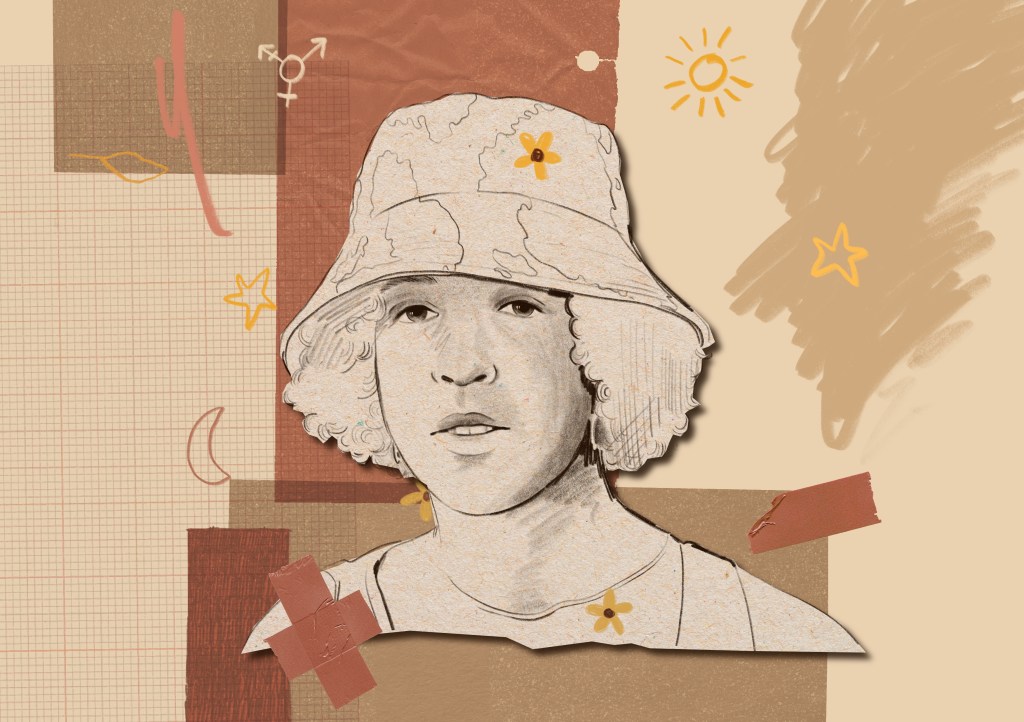
LEO: Today, we have an incredible guest, Elijah Ndoumbe, who is a multidisciplinary artist and moving image director working towards embodied methods of artistic connection, care and radical imagination. In this episode we discuss one of their most recent films Prayers for Sweet Waters, which was screened at Sundance and won best South African Short Film at the Durban International Film Festival. Prayers for Sweet Waters will be shown in the New Orleans Film Festival in November. So make sure to check it out! Also, Eli’s photographic work on sex work and queer narratives will be shown at the Rencontres De Bamako African Photography Biennale launching this coming week in Mali.
[upbeat drum based song]
INDIGO: This is Changing The Frame.
[upbeat drum based song fades]
LEO: Thank you so much for sending us the film. We really enjoyed it a lot. If we could start by just introducing ourselves. My name’s Leo and I go by he/they and I’m a filmmaking student. And do you want to say a little bit?
INDIGO: Yeah, I am Indigo, she/her. I mostly curate and programme film festivals.
LEO: So Elijah, if you want to tell us name, background, hobbies, any other creative practices that you’re interested in?
ELIJAH: Okay, bless. Yeah, sure. So Elijah or Eli is fine. They/them pronouns are fine, although pronouns can really be thrown out the door, in my opinion, but that’s a conversation for another day. Ee live in the world we live in, right? So I call myself an artist. I work primarily with lens based media, but I also have worked with food, with sound, with music. And really what interests me is, you know, storytelling, community and conversation connection as well. So I have a short film, Prayers For Sweet Waters, that I made with my team last year, which has been doing really well on the festival circuit, which is a blessing, which we’re gonna chat about today. But yeah, I also produce other forms of work. I have a few shows, group shows coming up this year for some photography work. And yeah, just you know, learning everyday, student of life, learning everyday also in filmmaking, student of film, you know what I mean? Like, there’s so much to learn, so. But yeah, thanks for having me.
INDIGO: Thank you for joining us.
LEO: You’re so welcome, yes, very exciting times.
INDIGO: What made you pursue filmmaking in the first place? And what roadblocks did you face when you’re starting out?
ELIJAH: It’s a good question. If you don’t mind, I’ll be sipping my coffee in between some of the some of these thoughts.
INDIGO: Go for it.
ELIJAH: It’s interesting. I feel like I kind of stumbled into it, you know, like, it was always present in terms of like, I grew up watching films, and I and I, and it was obviously a staple. For you know, for me and my childhood, although I do think I… How old are y’all, May I ask?
INDIGO: 26 almost
LEO: 23.
ELIJAH: You know, we’re not too, we’re not too far.
INDIGO: How old are you?
ELIJAH: I’m going to be 28 this year. Yeah. So I was gonna say I’m in the era of folks that like, I did a lot of reading. I was reading a lot as a child, you know, so I was that kid that was in school with like, the book under the desk. While everybody was doing their homework, I mean, doing their classwork. You know, homework was already done, like I was trying to read. And I bring that up to say that like books and reading and stories were like a huge part of like, my life. Period. You know. So, it makes sense now that I’m older and kind of, you know, we live in this world that is really image based and image focused that I’m moving into that realm, through film. Film allows that right like, film allows story to kind of come to the screen. But in terms of like, how I came to it, like I said, I stumbled into it. You know, I was kind of more interested in organising and community organising spaces in college, and activated across some different kinds of spaces with people in my communities, friends of mine, and then experienced like burnout. Near the end of my… of my college years doing that, and really had to, like, come back to the centre and ask the question of like, how is it that I kind of want to like, change things or contribute my voice or be a part of the conversation in a way that feels nourishing, and that also, yeah, just feels helpful, I guess. Or it’s contributing something different. And I realised that art was actually the way. In terms of like it being a mechanism and a tool for, for change. And so I started pursuing photography, and you know, more still image based work at that point. And then, when I went to South Africa, I connected with the sex workers education and advocacy Task Force in 2016, and was supporting them logistically just like in the office in the advocacy office. And then when they saw that I had some, like, artistic, you know, forte, they were like, actually, let’s put you towards some like media advocacy work. And so we started making some more media advocacy work together, and like a small kind of experimental short film came out of that. So it was really like these moments that led to me realising like, “oh, shit, I can do this”. Like, I can pick up a camera. And like film, like anybody can do it actually, you know what I mean? It’s just a question of just jumping into it. And now we’re here.
LEO: So we’re thinking, because we’ve been having conversations with other filmmakers in the last month and stuff. We’ve had a lot of chats about funding for smaller queer and trans artists. And we were wondering if you would like to talk a little bit more about the connection with BFI network and British Council to help you produce your film and everything? How did that come to be? How did that happen?
ELIJAH: Sure. Yeah, long story short… Somebody that I have a relationship with, who I’ve collaborated with briefly before, but it’s also just a friend, is based in the UK. And at the time, that we were kind of like putting together this proposal. You know, and it was also a buildup, like I say, like, this kind of work doesn’t just happen in like six months, like, obviously, it’s like several years of building relationships with people building trust, being present in the space. And so it was more of a question of like, something was burning internally in terms of like, I know, we can make something I know, we can make something, I just don’t know how, you know. And then it like came up, I saw the grant for More Films For Freedom, which is specifically a grant for queer work coming out of the continent and the Middle East in partnership with the UK. And so I hit somebody up that side, and I asked them “Are you interested in being, you know, the executive producer on this project?”, and that’s how we were able to tap into that. So all to say, like, I knew someone who was willing to come…come onto the project, but I would say for folks who are looking and may not know somebody directly, like, just also research people and reach out, because you never really know who might be interested in coming onto a project, especially because there are a lot of people who are hungry to cut their teeth, you know, and up and coming producers and such. So, it’s the only thing is like, there’s a lot of funding through British Council and stuff, but you have to have, like a British person be on the funding partner team. So, you know, thinking through that, and like building those relationships, so that, you know, that’s something that you can tap into at the right time, you know. So yeah, I mean, yeah, cuz if I didn’t have a British British connection, we wouldn’t have, you know, the, the project wouldn’t have gotten that funding. And I’m so grateful because BFI and British Council… the support was, you know, obviously… Some people in the filmmaking world might not consider that a budget. But I remember personally, that was like, the most money that I’ve made a film with, like, you know, it was it was a significant amount. And so yeah…
INDIGO: That’s so good. I’m so glad that you’ve got that funding and that you knew someone that could put you into that direction. I know you talked a little bit about working in South Africa and doing small, small projects around sex work and community based. What inspired Prayers For Sweet Waters specifically and how did you connect to the protagonists? So Wes, Gulam and Flavirina in the film?
ELIJAH: Yeah, so that was like a continuation again of like work that I had been doing. So, you know, as I said, like Gulam and Flavi, and Wes actually, like, I all met them when I first came to SA, South Africa, in 2016. Gulam and Flavi like we’ve known each other since I started working at while I’m in, I never started, I supported, I was a volunteer at SWEAT for a couple months in 2016. But when I, as in started that process of relationship with SWEAT, that’s also when I started that relationship with them. So we’ve known each other for years. And I’ve done like little things here and there, you know, like I’ve, I’ve helped support, like, curating shows, like just more artistically oriented things that I was putting on, facilitating kind of workshop…creative workshops, and they were part of that. So these were… How to say, it was like a continuity of conversations that were already occurring around, like, media advocacy, I guess “activism”, and I say this with quotes, because it’s like, there’s a lot of like, I don’t know, it’s not the right word. But you know what I mean? Like, just, I think advocacy is a better word, but essentially looking at that, and I was constantly kind of having a conversation with myself of like, “Where does film meet…? Where can film fit into that? Like, where can can that happen?” Because the NGO space can be quite small in the sense that, like, its smallness, isn’t like folks interact with each other in the NGO space. And then there’s like, a tonne of people outside of them that also don’t necessarily know what’s going on. And then beyond that, the NGO space has its own issues. So it’s like, how do you have conversations with the folks who are the protagonists who are directly involved in this line of work, or experiencing life based on whatever identities they might carry, or put on or the world puts on them, you know. And extending those conversations beyond just like these spaces and bringing it into an artistic realm. So there’s a few, there’s a few things. So there’s that continuing conversation, there was my personal journey as an artist and like trying to figure it out. And that’s still continuing today in terms of purpose and kind of marrying that to my craft. And then I… also, you know, the pandemic hit. And I worked on a short film called Deliver Me with a friend of mine, Jannous Aukema, who was the director, and Denise who was the sound person on my film, as well, she was also doing sound on Deliver Me where I was a DP. And that was, I bring up delivery, because it actually influenced also how I approached Prayers in terms of it being also a short film documentary following a delivery service bike driver in Cape Town from Malawi. And just like the approach that Jannous took with making that work, and the fact that we were a three person team telling, or attempting to showcase or tell someone else’s story, the ways we went about that intimately, just like not in like a traditional industry, filmmaking kind of way, made me want to proactively try that in a more directional manner with the work I had been doing with SWEAT and the sex workers there. So yeah, it kind of came came about in this like improvisational manner. And then when the More Films For Freedom grant application opened up, it was like, even more of a reason, to put it all together to try and take a shot. And we did and then, you know, we got lucky.
INDIGO: Yeah, that’s so interesting, like, it definitely feels very natural. The way you get all the conversations in the film. So yeah.
ELIJAH: We did… We did the conversations actually, after… after production. And I set up that space intentionally… actually, it was it was done at this place called The Workshop in Cape Town, which is Puleng Stewart’s, Jannous’s partners space. They have this beautiful recording booth set up, you know, with this garden, so you’ve got this like tranquil space. And it was so important to just like, bring each protagonist into that space and just have a conversation. Just continue the conversations that we’ve been having for years, but just have that in the context of this like holding space. So yeah, it’s cool to hear that. That’s that kind of related in the film.
LEO: That is so nice. Cause Prayers For Sweet Waters is documentary making, and it follows like the three protagonists and what they do and what they talk about. Is there any other type of filmmaking style that you could have considered for this? Like, do you think it could have been any other type of creative, more fictional style kind of film instead?
ELIJAH: Well, I think like we play with fiction a little bit, I mean, and the thing is, I think I think the question to ask actually is like, is documentary ever not fiction, you know? And I think that’s the question that we have to ask ourselves as filmmakers, as well is like, you know. And I think I was really struggling with that was like, “What’s my right with the lens?”. And you know, and because I also come from a space of understanding of the lens is kind of inherently violent is based on the history of it, and colonialism and the things that were done with that, you know, so, and how that continues to have like consequences and reverberations, like in the world today, culturally, you know. So thinking through that, and that was like, a big part of my approach to the work in general is like, I didn’t want to do traditional documentary filmmaking, I wasn’t interested in the traditional ways that people kind of set documentary filmmaking up with talking heads, or the fact that like, nobody’s compensated, or there’s no conversation around reciprocity, like. That doesn’t interest me in the making of the work, you know? So I think breaking into that space, in that kind of capacity. That question was already on my head in terms of like, what is the genre and like, actually, fuck documentary filmmaking, because in a way, it is already its own kind of fiction. And so let’s see what kind of realistic fiction I guess, in that line and frame line of work, we can create, while bringing people into the process… in that process. So I’m sure there, there’s a million different ways I could have done it. But the key also is that, like, it wasn’t just me, it was a whole team of people. And, you know, each person brought like something unique to the process. And I think, especially in post production, that really came through clearly with Denise and with Pierre and was also with job with assistants in the editing suite, you know. There was just people showing up doing what they did do best, while also being able to bring the context of like for a number of people on crew being queer, or being trans or being a person of colour in the context and understanding or having some form of relationality to the content of the film. And also being in conversation with our approach to it, which at the end of the day, as I’ve always said, I’ll continue to say was rooted in care, and in holding space for stories to just breathe. It wasn’t about trying to make a point. You know, if the side effect is like we talked about decriminalising sex work, and we talk about transgender justice. Great, because that’s definitely a part of it. But more importantly, like let people fucking breathe on screen and exist without having to it to be some huge sort of like statement without having it be sensationalised in that way. Yeah, I think there’s room for different ways of making it. But I think also where I was when we started making this work is I was mainly experienced in you know, kind of like amateurish documentary work. Like I hadn’t necessarily been making fiction, like, what one would consider fiction work. So yeah, it was also that.
INDIGO: That was so beautiful, like, let people breathe.
LEO: I feel like you managed to merge fiction… fictionality within documentary really well with how you use like, you show the… like the main people in the documentary, we see their houses, but we also get a glimpse at like, a very queer lens of Cape Town. And you show them being instead of like, like you said, like, it’s not a headshot interview or anything like that. You just like, following them about enjoying their day and during, enjoying like skating, walking about and everything that just felt very natural and very intimate and normal. Yeah, I feel like you really, really came through with how you filmed it.
ELIJAH: I appreciate that. The dream sequence themes or the scenes of kind of more, kind of more explicit fantasy or not fully of this, like every day intimate life was also kind of like trying to kind of blur those lines is it you know, and they’re very brief, but whether it’s was working kind of like that since sensational working space that we that we have was in their home, or the altar studio space that was created for Gulam with her affairs, that was also production designer, Jody Brand did excellent work in terms of just like the art direction of that scene and the different kind of elements that were present to speak to Gulam. And then Flavi’s dreamscapes scene which you see more of at the end, where she’s wearing that Miss Transgender South Africa sash, and she is the queen and she has one, you know what I mean? So kind of different ways, I guess of trying to, yeah, access these. I don’t know what I’m trying to say, but access to different kinds of realms that we’re speaking of here.
INDIGO: It’s so good to hear about the three protagonists, Wes, Gulam and Flavi. Have they seen the film? How did they find the film? Why do you think this story is important to be told, not only for a trans audience or for other people, but for them specifically? And for yourself?
ELIJAH: I wish they could be here to answer that question. Because I feel like I can’t answer it for them. But what I can say is, you know, it was emotional, like, it was really emotional, like, I went with Denise to show Gulam and Flavi specifically, was the saw the cut, because I think we were still, you know, pandemic stuff locked down by, so what’s called a cut electronically, and they said their feedback, and they were just, they… all of them were just like, you know, like, just felt it, you know, and I think we were trying not to cry when we all watched it together the first time. Like, when we were in one of the early cuts, and we were showing it to them, and you know. And I’ve always, I’ve always wanted to do right by them, and to make sure that they feel well represented, and that nothing feels forced or inaccurate. And so it was important to show them the work and get their feedback. And yeah, you know, in that process, like they, they felt it, and it’s hard for me to find words, because I’m remembering like, what their faces look like, and how they responded. And it was emotional, you know. And I, I would [oose], as we say, in French, [oose] I would, [oose] to say, I don’t even know how to say that in English, I would dare to say that I think they’re proud of the work, you know, and I and I’ve heard them say that to me as well, that they’re proud to be a part of this. And they’re proud to, to be in the work and, and they’re excited to see, you know where it goes. And I think from my own personal perspective, like this work is important, because people are important. Number one. People’s stories are important. You know what I’m saying? And when we start talking about folks who live at the intersection of transness, whatever that means, in today’s context, Africaness, sex work, like all of these things. And then their intersections in a world that isn’t valuing that as it should be, I think it’s incredibly important to have these narratives have space to just speak and breathe. Yeah, absolutely.
INDIGO: For sure.
LEO: Has making this film helped you explore your own identity in any way?
ELIJAH: Interesting question. I feel like all work in a way, like all… any work that you do, you know, it’s like, I feel it in like… I read that question yesterday and I was thinking to myself, like, that’s an interesting question. And maybe maybe at a different stage in my like, developmental space in terms of my identity, I would have answered differently. But now, I will say yes, of course, because I feel that like all work impacts you in some way. And like, there’s a reason I’m attracted to making this work and wanting to do this work. And I haven’t figured it out yet, per se, but it definitely has to do with like gender and race and like, conversations that intersect across that and I think, yeah, I’m still I’m still reflecting on, on the ways that it touched me. But I think it’s, it’s still revealing itself to me in terms of how it’s how it’s touched me, and I think it’s done. It’s doing so and it’s continuing to do so particularly in my… in my identity as a… as a maker and an artist. Yeah.
LEO: Such a good answer.
INDIGO: You mentioned being…. knowing some of the people that you’ve worked with, already. So I was just wondering, how did you choose the crew for this project? And are there certain people that you always like to work with? And also when you mentioned about intersectionality, seeing the credits, I can see that loads of people that worked on this project also have intersecting identities. So how was working with them?
ELIJAH: Yeah, amazing. Like I….
INDIGO: Every time I work with a trans person, I’m like, Yes.
ELIJAH: You know, you know, and I think it’s like, it makes all the difference. Like I haven’t, I don’t have… I’m very honoured to be on this podcast, by the way, because I’m just like, you know, the imposter syndrome sets in, I’m like… “me, a filmmaker? What do you mean?”. You know, like, I haven’t really been on like, huge commercial sets and things like that. So, you know, I hear through the grapevine, what the experience is like, or I have been, in my very brief stunt modelling, like, a few years ago, you know, I’ve been on sets where it’s like, yeah, like a lot of white guys. And it’s like, that’s kind of the norm, you know, or just a lot of guys, you know, so it’s just, I hear about that, and then what we had was so different. And you could feel that, you know, in the whole process, and I think, yeah, it’s a difficult one in terms of like, again, finding words for it, but um, definitely changes how the space is held. In good ways. It’s just a different ethos of like filmmaking, I think, and, and, in general, I knew for… I don’t always work with the same people per se, I am open to working with, with whoever it is that I’m connecting to, and feels like it’s an alignment for us to be working together. If that happens to be mostly queer people, or queer folks of colour, like dope, you know, but I’m also open to that not being the case. But Denise and I were working together already with Deliver Me and then I also had been working with them on this piece that I was doing around food and legacy, they had been doing sound with me on that. And then [Bas] had also been doing camera work with me on that. So in that light, you know, folks like that, in that capacity, like, we had kind of already been building slowly. And we were building up to Prayers, you know, because we were in our own relationship dynamics, also, just being like, we’re gonna do this, we’re gonna, we’re gonna get this funding, and we’re going to make this work. And this is how we’re going to do it, you know. And then folks like Pierre, who was my editor on the film, as somebody new that I hadn’t worked with before, also a queer, creative, and absolutely fantastic. So somebody we reached out to and was able to connect and come onto the project. And I think, also like throwing it back to when you talk about the genre of the work, and the way it comes across. [Piette] has a short film production company with their, their, their production partner in South Africa, and they predominantly work on short films, fiction. So I believe this was his first documentary short that he edited. And so I do think there is some of that energy from his experience editing, like narrative fiction short, coming into the process, like, you know, that was Prayers in post production. So, yeah, does that answer your question?
INDIGO: Yes, yes, for sure. Also, I was just wondering, how did the title come up, like working with all these people? Like, was it a collective title? Or did you come up with it, because it’s such a beautiful title and relating to religion and spirituality so…
ELIJAH: I, I actually came up with the title. I gave up with the title. I’m like, remembering the like WhatsApp chat from like, 8pm to 11pm. But just like sending title ideas, nobody responding and just being like, I know, they’re just like waiting for you to like, fall on the right one. So I was like, trying to come up, I was trying to just reflecting, reflecting, reflecting. And we’d had a couple people watch the cut by this point. And I also felt this in… in reflecting on the film and from the feedback we were getting is that like, there was and there is such a strong element of spirituality to the work and everybody’s story, like, I think especially the way that Gulam really just like is an anchor in the film for so many reasons. And in terms of just her presence and how… how her story connects all three. Both in the like process of like, literally like the technical editing and then just the way that it flows. And Gulam as a person is somebody who is tapped into that kind of embodiment. And so is Flavi, you know. So it’s like, it already existed in our protagonists. And then without us even trying to, it kept showing up in the work, it showed up in the way people were speaking, it showed up in the way the images were coming across, you know, the sacredness. And that’s something I also was chatting to… to folks about as what’s also important in the work is like, you know, these people and I say, these people, I’m like, I don’t want to use the word trans, because I’m trying to, like, come out of that. But like, our people, these people, trans people, like we’re sacred. So it’s like, how do we have something that communicates that “sacredity”. You know, I don’t know if that the word, “sacredity”?, but…
LEO: Sacredness?
ELIJAH: Sacredness, yeah, you know. And so there’s that element of it, the sacredness of it, the spirituality of it. And the fact that we open with a prayer, the fact that there is the prayer of, of, just like embodiment and existence, that everybody in the film has their own story, that translates in a different way, they’ve gone through their own shit. And yet, there’s still a message of like hope. And journeying beyond even the film’s moment, you know what I mean? So all of these things were thoughts that encompass like arriving to the title, especially including prayer in it. And then Sweet Waters is actually a translation of camissa, which was, was one of the names that folks indigenous to Cape Town’s area prior to colonial settlement, colonial settlements, excuse me, call it camissa, meaning the place of Sweet Waters. So it was it was a combination, it was a play on words, it was also an attempt to “how do we name Cape Town without naming it as Cape Town?”. This place that like all three of our protagonists, actually aren’t from as in even though Gulam is from the Western Cape, like she was from like a rural, outside of outside of Cape Town city centre. So nobody was necessarily from Cape Town city centre, but everybody came to this place of sweet waters, right? This place where also, you know, if you do research and you have some historical context, you know, that Cape Town was a dark city, and that it was a big city that was a because of that also was big, there was already a lot of sex work going on, especially at the docks. So there’s like a historical precedent, you know, there’s, there’s a lot of different things to speak to. And I was just trying to figure out in the title, how to gesture to these kinds of different things that were present, or that are present in the story.
INDIGO: Yeah. So good. And talking about journeys. Now, your film is going places, right? You have your film at Sundance, which is great. What impact do you want your film to have both within the trans community and in general? Because I feel like Sundance has a very cisgender audience. So if you could talk a little bit about that as well.
ELIJAH: Yeah, I mean, honestly, total shock. Sundance was a total shock. Like, we were obviously, you know, we were trying for… for the big festivals, like we try, we got a lot of nose. You know, so when we got Sundance in freaking shock, like I was just like, no way, you know, no way. So still processing that. Still processing that, you know, I you know, Sundance might have a cis audience, but you know, who has probably even more of a cis audience was where we, were we premiered at Hampton. I don’t know if you know Hamptons International Film Festival.
LEO: It rings a bell. Think I’ve heard about it.
ELIJAH: Yeah, so proud of that one. It’s an Academy Award qualifying fest. And this is the only programme five, I believe five short films. So we were part of in terms of the documentary section. So we were part of that. Love the programming team there. Love that. So big shout out to the Hamptons programming team. Amazing people. But yeah, also it’s just quite interesting to see how it was received. And I say I was physically there for that as well. So we actually had really good conversation in that space but um, yeah, most of these festivals is gonna be a cis audience unless you’re at like a queer festival, which we did NewFest. And that was, that was like, it wasn’t until we did NewFest and I was physically there for that as well that I was like, “Oh, this is different”. Showing to like a room of like, predominantly queer and trans folks is a different feeling for sure. Sundance was online this year. So I don’t really also know, you know, how were the reactions? Like how, how that that might have gone on? I do think it worked more in our favour that it was online this year, because we were a short. And because a lot of folks in the in person festival programmes tend to just kind of like prioritise the features, I think. So people had more time to watch more films this year, which actually kind of works out for those of us that are not necessarily doing features. But back to your question. festival circuit, where it’s going to impact, you know, in terms of community, let’s start there. I hope that people can see themselves in the work. I hope that they can, if they don’t see themselves at least see someone in their circle in the work. Yeah, it goes back to that thing of just like, what interests me is like how stories can breathe. I think with trans narratives, especially those of colour, there’s just like a weird sensation rising thing that’s happening in the media right now, a very flattening thing that’s happening in the media right now. Like, I have to take a moment now and just be like, like, it’s a lot being alive in a time where people are actively trying to just like, take away your rights or already have, and I think I’m, you know, as we’re recording this, I’m in, I’m in Los Angeles right now. And there’s just like, so much shit coming out in the states that are just directly targeting trans people, you know? And trying to figure out how to like, even, is it worth the response? Do I respond? You know, when you’re somebody who’s a student of history, or who’s done a little bit of research, you also understand that this is like a fucking pattern. Like, every time there’s an election season, we become up for grabs. So it’s like, I don’t even know if it’s worth it for me to fucking be involved in the conversation. So all of that to say, there’s so much going on. And part of me, some of the impact I want to have is just like, can we just see ourselves? Can we just see? Like, I definitely would like there to be more impact. But I don’t know how to do that in a world that doesn’t feel like it’s listening. So that’s just my personal base, where I’m at right now. Which is why I’m like, you know, in terms of impact, it’s about figuring out those pathways with the people, you know, so I’m, I’m constantly in conversation with like, with them in Flavi and Wes around, like, when because it also takes resources. That’s the other thing to talk about. This is a filmmakers podcast, right. So just being realistic about the fact that like, you know, I have also like, spent my money on this project in a manner where I have to now recoup. And these things cost money, whether it be like screenings, or like putting the work out or whatever. So just trying to figure out a pathway. And that, you know, we’re building up towards that, I think I definitely want to do some impact screenings, we’re still at the early stages of distribution right now in terms of being in the festival circuit. But I’m in chats with, like, different people around what it would look like to do activation spaces. And that was the thing from the beginning, like, before we started shooting is like, I want this film to be something that can activate people. And that was also a conversation I had with the people in the work right? Like never, never gonna like put the work somewhere where the folks in it don’t want it. So they’re aware that they’re being seen, right. And because all three of them in their own capacity also have been functioning as, as as folks who are working in advocacy, whether it be in sex work, whether it be in Trans Justice, or sex worker advocacy justice, they feel comfortable having their face be attached to something that’s also going to be tied to like speaking about that. So we’ve discussed, what would impact look like whether it looks like panels or doing workshops or things like that, but that obviously takes like people bringing the film out, and also having the resources to like, make that happen. So those are some of the things that I would like to see happen in terms of just like, what would it look like to get policymakers in a room to watch this work and like reflect on it or have it be a part of a lineup that addressing these kinds of conversations? Because yeah, I think this kind of work can have an emotional and like spiritual impact on people who watch it, hopefully. And that that can make a difference. You know, some times more than like talking at people or trying to get people to reach it can do so. Yeah, you know, I would like to definitely activate it in community. So people can also just like, reflect and have different kinds of things they can discuss with one another and see one another in the work. And, but and also, you know, again, how do we bring the spaces where folks need to see it, who are enacting the policies, or the laws that are impacting these very people? So I’m open to that. And I’m hoping that that will, that will, you know, reveal itself in terms of like, how it will land in those spaces. Yeah.
LEO: And now that we’re talking about influences and impact, I kind of wanted to ask you, if, because you’ve done so many different forms of art in the past.
ELIJAH: You’re making me sound so experienced.
LEO: Yeah exactly, because you’re like, you’ve, you’ve been there, you’ve done that you’ve been all over. I wanted to ask if there’s any artists, any type, that have influenced your work in some ways, and how you’ve like picked apart things, to use them yourself and do your own stuff.
ELIJAH: You know, Arthur Jafa just keeps like flashing in my head right now. I’m always referencing him. I hope he like if he ever hears me referencing him…. I’m just dropping his name. And honestly, yeah, it was it was a he had a… his film Dreams Are Colder Than Death, Dreams Are Colder Than Death had a big influence on me. Just stylistically, in terms of like, how he approached a “nonfiction”, say that with air quotes, again, kind of topic. And he was looking at, like Black life and extensions of different conversations around that with artists, intellectuals, and so on and so forth. But anyway, how he makes work, his I, his conversation, definitely is an influence on me, I would say, you know, I’m very bad at remembering specifics, unless I like see them or I have them like bookmarked. So this is always one of those hard questions for me. But that was definitely somebody that came up for, I would say, it’s more also like, people who’ve had impact on me, or I’m in relationship to so another person who I’m really, really grateful for his Dream Hampton, who’s a filmmaker, stateside from Detroit, and we met in, I’m gonna get the date wrong, but I want to say it was 2015… Yeah. And Dream and I, you know, had conversations and I asked her questions around filmmaking and the process, and she was one of the first people who often tell me, you know, the, “the lens, the camera always changes things”. So, you know, to be aware of that, and, and how to move and to think, think about things like that. So, I would say my biggest influences are the people that I’ve either received mentorship from or advice from or work with, and I include, like SWEAT in that I include the, the aunties, and the folks in the advocacy office. And the conversations we had that, like informed my process, I include, you know, South African artists and image makers, who are, you know, actively engaging in these conversations around what it means to be aware when using a lens or its linkage and conversation with these conversations around decoloniality, which is like a big word, you know, but just like, what, what, what do all of these things mean? How do they translate and the ways in which people are using that? So? Yeah, I think it’s an amalgamation. It’s an amalgamation of all those things. In terms of specifically in film, though, like I also really adore Céline Sciamma’s work.
LEO: Very nice.
ELIJAH: Yeah, I want to work with her so bad. I had this idea for this like, period piece, just like I just need to get Céline Sciamma’s contact. A gender nonconforming period was like, listen yeah. But like, I love just folks who work with like, I don’t know, it’s like, a poetic sensibility to their image making and, and, I think, you know, Arthur Jafa to me also does that, you know, there’s a there’s a there’s a poetic sensibility to his work. And so I think maybe it’s just a question of artists who are in some ways positioned to like, think about these things that we’re talking about now and who are imbuing it in their work in their own way?
INDIGO: Honestly, your film was incredible, but just listening to you, I’m just like, taking everything in.
ELIJAH: Wow.
INDIGO: It’s incredible honestly, I feel like specially like, I’m from Brazil. So whenever I watch something that’s trans related, and intersects with different races and stuff, it definitely like, it’s close to my heart, you know, so I was, yeah, the film really impacted me. And it was incredible.
ELIJAH: Wow, thank you so much for sharing that.
INDIGO: And I’m really looking forward for future projects. So would you be able to tell us a little bit about future projects? Any hopes or expectations that you have for your career as a filmmaker? Or in any other different types of art as well?
ELIJAH: Yeah, I mean, yes, there’s a few things that I’m like in development on in terms of like, the early stages of like gestation and getting it together. There’s a short fiction film that I really want to get off the ground. It’s essentially following a trans masculine character in a cruising space at the beach at sunset. And it’s like, a gay male cruising space. And I’ll leave it at that.
INDIGO: That sounds amazing. Alright.
ELIJAH: So yeah, so I’m working, that’s something that I’ve been marinating on, you know, constantly thinking about, one of the things that’s been at the forefront of my mind has been the conversation around trans masculinity and trans masculinities. And how invisibilized it is, and how, again, flattened this, like, it’s like trans men only, or even within that paradigm, it’s not even about like trans men versus non binary people, because it’s not even my point. But there seems, there’s like, there’s a, there’s a, there’s a, quite a violent language attached to like trans masculine identities and how people perceive them, even within the queer community. And so I think, part of like shifting the conversation around that is just like telling more stories that again, enable breath and space for those of us who have existed, you know, in so many different modalities and forms of expression. And so it’s short, it’s exploring that intersection happening in a space that is like, typically dominated by like the eroticism of mainly cis gay men. And then what happens when somebody in that space maybe occupies a different kind of context and is being sexualized? Or is experiencing sexualization? And what are the different kinds of like, silent conversations or uncomfortable moments that can arise for either parties in those interactions because of like, the expectations around the interaction. So that’s one that I’m currently working on. I also, you know, I’ve been working on this photo series, called Try A Little Tenderness, which is centering folks who identify along the spectrum of trans masculine identities and predominantly are of colour. And that’s like a, kind of like an experiment and conversation between myself and each person around the intimacies of our experiences. And I want to develop that into like a short docu- docu-film, in a similar kind of stylistic manner as Prayers in terms of like the poetry of the images and kind of working more with like a quiet you know, artistic environment. And then, like I said, I’m trying to get Céline Sciamma on this.
LEO: Let’s get Céline involved!
ELIJAH: I mean, like, literally, yeah, there’s this. I want to adapt this older, erotic literature novel, that was written in 19th century in France, and it literally has… centering gender nonconforming folks in it. It’s like a period piece and I always thought it would be so interesting on film, so I’m looking into that, but these are all things, obviously, that I’m also juggling with, like, you know, trying to make money and, and, and everything else. So it’s a combination of all of that. And so, you know, to me all of the work speaks, speaks to each other, you know what I’m saying and so whether it’s doing that, or whether it’s doing another activation with [Bienvenue on my tableau], which is like a food project that I do, where, again, we’re cooking, and legacy and familial connections kind of come into play, which is something I’m going to be activating with a friend of mine later this summer, stateside. So it’s a lot of moving a lot of moving parts. But that also, you know, keeps things exciting and keeps things feeding one another as well, that’s a really important thing is like, I am not interested in just staying in one avenue or one industry, you know. And I think, I hate to be cliche, but part of like, the ways in which my like transness or nonconformity, like translates in my work is also the ways in which I work across different disciplines and mediums to like, express what needs to be expressed, you know, that’s what I got going on.
LEO: You’re an absolute inspiration. I’m so happy we’re talking to you right now. We’re almost getting to the end now. So we wanted to ask you, if you had any type of advice for anybody that’s like, thinking of getting into filmmaking, or even just like going cross media and trying different things as well, like you’ve done.
ELIJAH: Ah, I’m like, there’s a lot. Okay, let’s see. Go were it’s warm, which is something that someone told to me, which I really appreciate, go where it’s warm. And when I say that, I mean, like, go where you feel love, go where it feels good. Because the best work will come out of that. Prioritising your health and your wellness first, because the best work will come out of that, you know, so I think that’s like the first thing. And then I, you know, especially in places like LA and Cape Town, I think could be a lure of like, same or like industry or like making it can be a thing. And I think actually cutting all that noise and all that shit out is like imperative and rather focusing on like, who’s coming up with you, because those are the people who are going to be with you like when you are established. Because it that’s the goal to be established in whatever career you’re you’re pursuing. Focus your energy on people, that vibe with you, that want to work with you, and that have similar values that you have in the work that you’re making. So not just people who are like, good at their craft, but also folks who align in the value in the kind of work that you’re trying to make. I think it’s very easy to get distracted in the world that we live in and feel like you should be working with this person or you should be here. Oh, also that! No comparison. No comparison. So I would say yeah, there’s so much I would say, but don’t compare yourself. Delete social media.
INDIGO: Yeah.
ELIJAH: For like, weeks or months at a time, it will help the creative process, you know. We’re not made to be consuming so many images all the time. So, you know, I’m like, what advice I’m like, so much advice. I mean, yeah, so you know, go work form. Focus on people who are in alignment with you. Start with whatever you have, like, if you don’t have the gear, that’s fine. Start with a pen and paper, like, start building those dreams and images in your own space, then if you can access like a phone, that’s a filmmaking tool, like you don’t need these, like big fancy things to make the work you actually just need, like a few people stuck with you. And which can even just be yourself, you know what I mean? And, you know, and, and just the discipline, I think. So, one of the things that I’ve been trying to do is creating a bit more discipline and, and in my practice, and that doesn’t look like being militant with my shit, or like, you know, taking the joy out of it, but rather creating containers that will make me curious enough to want to learn more and want to keep practising my skills every day. You know what I mean? So I think doing that, and then finally, what I was gonna say is making sure that you have time scheduled in for nothing.
LEO: Yeah.
INDIGO: Those are great advices. Yeah. They’re like everything that I need to listen.
ELIJAH: You know, and the last one is real like and when I say that, I mean it’s really not is like… I like to take walks, or sit in the sun, you know, or do something kind of mundane, you know, and even just like sitting and doing nothing, because things will come to you then because your brain is working so hard when you’re working, working, working, you’re creating, you’re collaborating, you’re talking, we’re talking now. And then when you sit in a patch of sunlight, if you can, you know, and you’re listening to the birds, and you’re just reflecting, that’s when things can marinate and come to the surface that can answer questions for your creative projects. You know what I mean?
INDIGO: Completely.
ELIJAH: So that would be my advice.
INDIGO: Honestly, yes. I was just wondering… Sorry, I’m still taking all of that in. What other queer media would you recommend for our audience? And that could be films, books, podcasts, anything, music?
ELIJAH: You know what, I’m gonna do some Googling while we’re here, because I can’t remember everything.
LEO: That’s totally allowed.
INDIGO: You can always send us some of the recommendations for us to share on our social media.
ELIJAH: Absolutely. So I watched a film at NewFest that really touched me. Korean, a Korean movie called A Distant Place. I don’t know if y’all have heard of it.
LEO: No.
INDIGO: I haven’t.
ELIJAH: But it follows a sheep farmer who’s living in this kind of remote area. And then the arrival of his lover and his sister kind of disturbed things a little bit, but it’s such a beautiful piece. So I would say, that comes to mind. I have this on my bookshelf, which I like to read things kind of, in and out. So I’ll pick things up, read some put it down. I got this last year. It’s called We Want It All: An Anthology Of Radical Trans Poetics, edited by Andrea, Andrea Abi-Karma and Kay Gabriel I hope I said their names correctly. But it’s beautiful. It’s like a collection of pretty much all trans poets and prose writers. And they’ve all contributed as anthology. So definitely that speaking of writers Thirty Names Of Night. I read that about a month and a half ago, but yeah, by Zeyn Joukhadar. And like that, was the first time I read a book, where somebody’s like, yeah, encompass the trans, like, gender non conforming individual in a way that just like felt natural, and I just… please read that book. It’s so good.
INDIGO: I will.
LEO: Looking it up right now.
ELIJAH: You know, and I’m also like, you know, purchase and support trans authors as well, which is why I’m putting that forward, because it’s like, it’s really real, really, really, really beautiful work. Yeah, that would come to my mind. I’m trying to think of anything recently, because, you know, I’m all about the queers. You know. What have I watched, is there anything I’ve watched, I watch a lot of things. There’s also the other because I watch a lot of shit. So I’m like, trying to sort through my head, but I’m trying to think about. Yeah, and then other than that, like, you know, classics like Cheryl Dunye you know, in terms of like, classic work, you know, filmmaking work. And I don’t mean to be a shameless plug for the mainstream, but Kehlani just dropped the new album.
INDIGO: Literally, just her whole energy. Like, I really want to be a single mom. So she’s, and this album is all about healing. And I feel like it’s a great, like, I just connect so much to it in the moment that I’m in my life right now. So, so thank you for mentioning Kehlani.
ELIJAH: I mean, look, you know, I’m saying like, this is what I mean, like being attracted to people whose work is rooted in like, making with care, and you can hear that in her work. And she’s been sharing that, you know, they’ve been sharing that in their process as well. And you can see it with the, with their whole crew and everything. So it’s also a shout out, you know, Kehlani I’m trying to work with you if you ever hear this podcast so sure, trying to build that, you know, that cross continental trans queer connect, connect… So but yes, so that’s what I can think of no I’m sure. Well, yeah, I mean, shame. Yes. I was gonna say I’m sure I can think of other thing… other folks. other mediums and I just thought about it right now. Somebody that I adore and admire very much by the name of Kiyan Williams. K-I-Y-A-N Williams, they’re having their debut New York City solo exhibition called Unearthing at Lyles and King. They’re just like a fantastic artist, go observe. They work a lot with natural elements, and just a variety of things being in conversation with like, different systemic issues slash histories, transatlantic history. So, you know, that’s an artist that I really, really admire. You know.
LEO: I’m on the website right now. And this looks absolutely incredible.
ELIJAH: They’re incredible. They’re absolutely incredible, you know, so, but again, you know, these are people that I just absolutely look up to, and then and are inspiring. You know, another friend of mine, also, Jay-Marie Is Holy they’re a musician and artist. They run a space called Black Transcendence, which is made up of like a number of different things. But like, for example, this week, I’m going to be in Atlanta with them archiving and documenting the Black Trans Bike Tour experience. So, you know, there’s folks out here people are doing stuff, people are making space. And it’s important to uplift and support and centre that.
LEO: Absolutely.
ELIJAH: So I’m just grateful to, yeah, being connected to, it’s quite exciting to be in a time where it feels like no matter, the medium folks are doing their thing. So, you know, whether it’s music or writing or film.
INDIGO: For sure.
LEO: Last question would be, which I think is very funny, because you’re talking about deleting social media earlier, where people can find you and your work.
ELIJAH: Ah, okay. So yes, they can find me on my website, which is my first and last name, Elijah Ndoumbe. E-L-I-J-A-H N-D-O-U-M-B-E dot com. And they can find me at that handle as well on Instagram.
LEO: Very nice. Very, very nice.
INDIGO: Thank you so much for joining us today. It’s honestly been a pleasure to talk to you. And I’m literally taking everything in.
LEO: It’s very funny. It’s so funny, because I was like, listening to you talk. And I was like, damn, I would listen to this podcast. I was like, Fuck, this is good this is really good.
ELIJAH: I appreciate y’all. Thank you so much for like having me and asking these questions and listening to me blab. But I appreciate it.
LEO: It’s been a total pleasure. So good.
[upbeat drum based song]
LEO: This conversation has been incredible. We just want to thank Eli so much for joining us today. It’s been a pleasure.
INDIGO: Make sure to check out Prayers for Sweet Waters at the New Orleans Film Festival in November. and Eli’s photographic work on sex work and queer narratives will be shown at the Rencontres De Bamako African Photography Biennale launching this coming week in Mali. Thank you so much for listening to this amazing episode, and stay tuned for our following episode next month.
[upbeat drum based song]
 Changing The Frame
Leave a comment