[upbeat drum based song]
INDIGO: Hello, everyone and welcome to Changing the Frame. We’re your hosts. My name is Indigo Korres and I use she/her pronouns.
LEO: And my name is Leo Torre and I use he/they pronouns. We are a podcast that discusses trans and non-binary experiences in the film industries. Every episode will count with the appearance of trans and/or non-binary multimedia artists in the film industries to talk about their work. We’re really excited to share these amazing talks and discussions with you all.
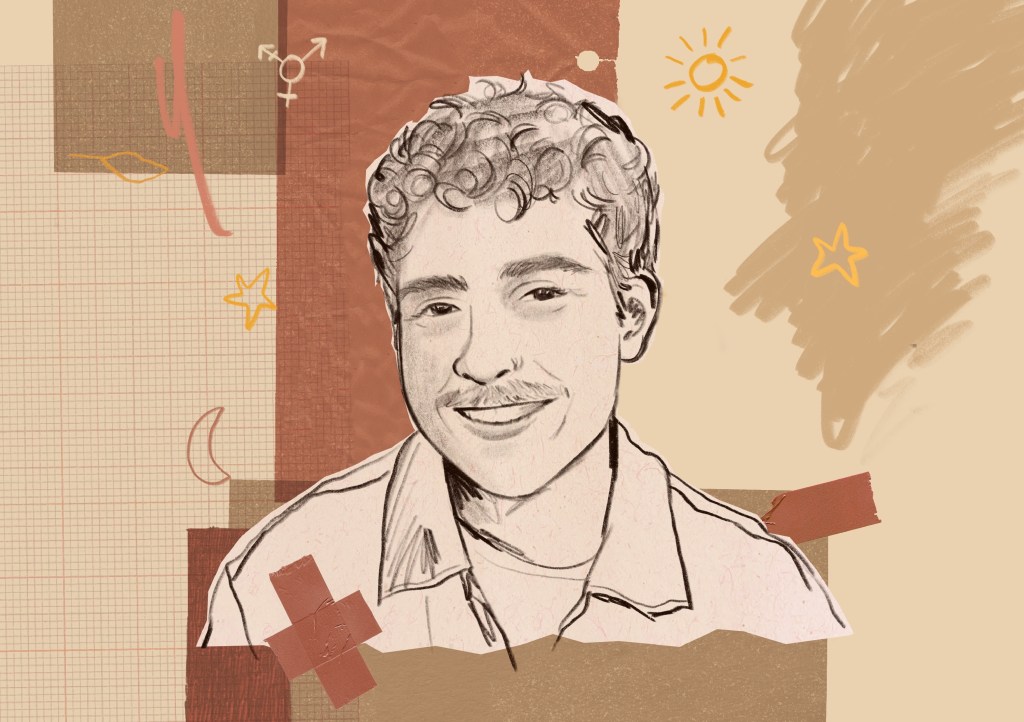
INDIGO: Today we have a very lovely and incredible guest, Milo Clenshaw. Milo’s a curator and writer based in Hawick in the Scottish Borders. He currently works as a program assistant for Alchemy Film and Arts, the home of Alchemy Film and Moving Image Festival, Scotland’s festival of experimental film. His work aims to centre marginalised voices and he believes in the art as a powerful tool for social change.
[upbeat drum based song]
LEO: This is Changing The Frame.
[upbeat drum based song fades]
LEO: Hello everyone. We’re here with Milo.
MILO: Hi.
LEO: First of all, we would like to ask you about yourself and your background. So if you wanna chat a little bit about who you are and what you do.
MILO: Yeah. So I’m Milo. My pronouns are he/him. Right now I am a program assistant with Alchemy Film and Arts, which is a film and community arts organisation based in Hawick in the Scottish Borders. We have an annual experimental film festival, every April, that is Scotland’s Festival of Experimental Film. But the rest of the year we also do community filmmaking projects, screenings, events, workshops, all sorts of things. And I also do a little bit of freelance curation, writing, other things, stuff that comes up.
INDIGO: I just wanna say that like I really like Alchemy and I’m very excited for this year for the festival.
MILO: Yeah. You’re gonna come down.
INDIGO: I am. And I also have to say that I’ve known Milo for like seven, eight years. So…
MILO: Yeah. It’s been a long time.
INDIGO: I know that you’re a film curator. How, like… What made you pursue that career and what roadblocks did you face when you were starting out?
MILO: I’ve always been interested in films, storytelling. I think I always knew I wanted to work in the arts in some way. When I was at school, like media and English was all I was really interested in. I had a really great opportunity… I grew up in Edinburgh, so the Edinburgh International Film Festival was there and the Fringe and there was always a lot of kind of art stuff going on, which was really great to kind of grow up around. And I had the opportunity in 2014 to join Edinburgh Film Festival as a young programmer. So I was part of a group kind of curating the Youth Strand for the festival. And I did that for three years. And that was really like, I guess what introduced me to what curation is. I think before that I didn’t really know that that was an option that you could do. And I think it just made a lot of sense for me, cause I really like film and I believe in film as something that can kind of create social change and is really important to culture. But it never really felt like something I wanted to make. It always felt like the stories that other people were making were more interesting to me than things that I could do. So I think curation was a nice fit for being able to like highlight things that other people are doing that I think are interesting and kind of make other people’s work more visible.
LEO: Oh, well I think you’ve answered my next question as well, a little bit to be fair. But if there’s anything else about your journey into film creation and organising events for queer audiences that you would like to share now. Is there anything you’ve done recently?
MILO: I mean, I kind of started out with curation doing that young programmers thing. And then I went off to uni, which is where I met Indigo, at Bristol Uni and I studied film and English. And that was a really good opportunity as well, not necessarily the course itself, although that was really interesting and I feel like I learned a lot, but just being at uni and having the time to kind of pursue other work on the side, I think. It’s like anything in the arts where, you know, it’s only really accessible when you’re starting out, if you’re able to do things for free or if you know you’re willing to work unpaid. So being at uni that kind of meant had the opportunity to do that, which, you know, it’s a sad state that that’s where the industry’s at. Yeah, I think I did a few little projects at uni. Some filmmaking stuff, some curation stuff. But near the end of my time there, I got involved with the Palace International Film Festival, which is based between Bristol, London and Berlin. And that’s an offshoot of the Palace, which is this kind of artist residency that runs every year in Poland. So the film festival, it’s all kind of queer, experimental, really interesting stuff and it’s all volunteer ran. So that was like a really cool opportunity for me to get involved with that team, cause they kind of just let me do my own thing and curate what I wanted to curate. And it meant I got exposed to so much new cinema experimental film, which before then I hadn’t really… I think I knew I was interested in it, but I feel like with experimental film, experimental cinema can feel a bit difficult to get into just in the, because it’s maybe more DIY, more non-narrative. If you feel like you don’t understand it straight away, it can feel like you’re not allowed to kind of have an opinion on it or get involved with it. So that was a nice kind of introduction to that. I fell in love with experimental cinema there, and actually I feel now the way I feel about experimental film is that it is one of the more, the most accessible forms of cinema because anyone can make something experimental. And experimental film is not about being pretentious or making something that people aren’t gonna understand. It’s about making things that don’t necessarily fit into standards of cinema, like Hollywood, mainstream ideas. It’s about being creative and expressing your identity and your community. And I feel like queer cinema and experimental cinema have a lot of overlap. So yeah, I got involved with the Palace, ended up going to the residency with them in 2020 and running some film stuff with them. So that was really cool. And then I started working with Alchemy and ended up where I am now.
LEO: That’s so brilliant. So good.
INDIGO: I also find low budget, like very experimental short film, the most interesting stories that people submit to festivals. I just find it so raw as well. They’re so beautiful. Yeah. It’s, it’s lovely to hear about your journey. I was wondering if you could. Talk a little bit about in what ways that you tell stories through your curatorial practice. So how do you put all those films that you watch together? Like how do you create a program that you really enjoy and that you feel like your audience is gonna like?
MILO: Yeah, definitely. I think for me, when I, I’m curating a program just personally, I always feel like film curation should be socially engaged. So, whatever you’re saying is political in the way that all art is political. So there needs to be a diversity of voices, a diversity of experiences represented across the program, just as kind of like a baseline. And I don’t think that should ever be something that’s considered to affect the quality of the program. I think sometimes people feel like you can be diverse or you can have like the best films. For me, I think quality comes from that diversity of experience. If you’ve got lots of voices kind of saying different things, then you’re gonna have a really rich program and explore things in different ways. And I think if you bring films together that you wouldn’t necessarily think of as having the same themes, they can speak to each other in really interesting ways. Yeah, I guess it depends whether you’re curating for a certain event or towards a certain theme as well. One of the things I did recently in 2021 was a program for Queer Borders Film Festival, and that was really open. It was nice. I kind of had the opportunity to just curate a queer program, but that was all the parameters that there were. So that was really exciting and I decided to focus that program around identity in the body and how as queer people we show ourselves on screen and are also reflected back on screen. So the films in that program were all around the body, but from different perspectives. So there was like, a documentary about fat trans people and their bodies and how they kind of exist in that queer fat radical space. There was some animation, some experimental stuff. Yeah, just films that I love, like I think you always wanna program films that you are excited by, and you think are gonna speak to each other in interesting ways. But yeah, that’s I think always what you want from a program. When you put them together and you start to see new things in the films, when they’re put side by side that you wouldn’t get from them individually.
INDIGO: That’s beautiful.
LEO: I think that from wanting to do something that you love and then being able to do it as well, there must be some barriers because if we go back to a conversation about experimental filmmaking and how it allows for people to do what they want to do and what they love doing, as opposed to big mainstream films where there’s like a lot more restriction. Do you think that the accessibility regarding funding for trans projects, has these restraints? Is there kind of funding opportunities for trans projects in this type of area for making screening programs? And have you accessed any of these opportunities yourself in the past?
MILO: Yeah, absolutely. I think what was saying before about experimental film and kind of that DIY ethos… it’s like a bit of a double edged sword where obviously experimental film, it’s so open, anyone can make it. You can make it with no budget, you can make it on your phone or whatever, just with a group of friends and you can make things that are more political, more kind of edgy than if you were getting mainstream funding. But then obviously, and it’s a lot harder to turn that into a career, make something that’s fundable, that can get around festivals or wherever you want it to go. I think that’s why you see that a lot of kind of queer and experimental filmmakers are multimedia artists. I think it, it goes with the territory anyway. People who are interested in that kind of art making, usually wanna do a few different things anyway. But I think it’s also the case that you can’t just make those kind of films and also, pay the rent necessarily. Yeah. I think I have accessed some funds that are specifically for queer and trans programs, and I know that they do exist for filmmakers and things. I kind of feel in two minds about it. I think it’s great that these opportunities exist, but they also can be a little bit exploitative of our experiences. When you’re expected to, first of all, you’re only getting funding because you’re making something about your life and your trauma and your identity, but also you’re then expected to like capitalize on that. You’re not allowed to just make something about life where you also happen to be a trans person. It has to be about, you know, the trans experience in quotation marks, but we, I think as like trans creators, art workers, whatever, have to just take this money and turn it into the things we wanna make as much as we can. I think the tide’s definitely turning. I think more mainstream funds and opportunities are kind of becoming aware of diversity and encouraging diverse artists to apply and not necessarily just creating these kind of segregated funds. But then at the same time, I think especially in the uk, the arts landscape is getting more difficult to access anyway. We’re in a cost of living crisis and there’s no money anywhere for anyone. And I think marginalised people like trans artists are gonna feel that more. Yeah. Which isn’t that positive an answer, but yeah.
LEO: It’s not. It’s not. But. It’s, it’s an important answer all the same. There’s, yeah, like you say, so much pressure for trans stories to be about the trans experience in inverted comas and like capital letters. So, yeah. That pressure is very noticeable.
MILO: Yeah, definitely. Not to like plug where I work, but that’s one of the things I love about Alchemy because it’s not explicitly a queer organisation or any kind of, it doesn’t represent any specific group other than experimental filmmakers and artists. But there is definitely a political focus in the films that get shown at the festival. In that there are a lot of like queer and trans artists there’s a lot of Black, POC artists, there’s a lot of women. There’s very consciously, not a lot of white cis het male American filmmakers who are in the program. And that is definitely like a conscious choice. So it’s, I think that’s something that I’m encouraged by and I wanna see more of in the curation landscape is this kind of more holistic conscious curation where it’s not, you know, we’re making a trans program and that’s part of the main festival, but it’s like one individual program. But instead you’re seeing trans filmmakers across a whole program and they’re just kind of everywhere. And trans stories are just ingrained into the fabric of a program rather than being in their own little island.
INDIGO: That’s really good. And in terms of talking about alchemy and funding opportunities, I know you got some funding last year for a program that I really enjoyed called Anything Could Happen Here. And you had a lovely panel of filmmakers to create an episode for the podcast, Tender Loving Care for Trans-Led/Trans-Loved Cinema. And you showed two films for that program. One of them, we’ve had the filmmakers here on the, on the podcast before, so that’s Ivor and Rosana with The Making Of Pinocchio. But also there was a borders based young people film called No words. I was wondering if you could talk a little bit about the process of creating the program and how you chose those films specifically and the panellists for the podcast.
MILO: Yeah, definitely. Thank you for introducing me to that film, by the way, because I find out about The Making Of Pinocchio through you, Indigo, so thank you for that. Yeah, I was really, I guess the idea with this program was for people who don’t know, Hawick is quite a small town in the Scottish borders. It’s town of about 9,000 people, so pretty rural, pretty small. There’s no train station. There’s buses that come like once an hour, so it’s not very accessible as a place to come to, which also goes both ways. It means people who live there can’t really easily leave as well, and it’s a place that scores highly on the Scottish index of multiple deprivation. It was a milltown back in the kind of sixties and seventies, and then slowly as that industry kind of shut down and they lost the train line, it sort of lost its identity a little bit. And it’s still a really like great place to live and there’s really amazing people and a lot of artists that live there actually. But I think it’s just somewhere that needs a bit more love in terms of money coming to it from the central government. You see a lot of opportunities going to Central Belt, to Edinburgh and Glasgow, and not a lot kind of trickling downside. So I guess the idea with this event was to program something. Not mainstream, but like a big film alongside a film made by emerging filmmakers from the town. These young people who had worked with Alchemy on a filmmaking workshop. And just to kind of have a trans event in the town is kind of something that doesn’t really happen. And yeah, I guess that’s another consideration with when you’re putting on an event in a rural space, you kind of know you’re not gonna get the same audiences that you would if you’re putting it on in a big city. If you have like a few people in the room who are really kind of excited to be there and who get a lot out of the experience, it feels almost as it’s just as special, potentially even more so than if you go to a sold out screening in a place where this is the kind of thing happening a lot. So that’s really what I wanted to do with it, is to provide that opportunity in a place that doesn’t often get things like that to kind of platform these emerging artists, to bring Ivor and Rosana, established artists to Hawick so that people could kind of experience their art and get to know them. And it was a really lovely day. I really enjoyed the screening and the podcast recording afterwards. Thought there was some really great conversation going on. I didn’t have to do much. They were all just chatting and having a great conversation. I could kind of sit back and enjoy it.
LEO: That’s so lovely. Oh, go on.
INDIGO: No, I was just gonna ask about the title for the program. How did you come up with the title? And also, I was gonna ask about the funding, like how was it to get the funding as well, since we talked a little bit about the funding before.
MILO: Yeah, sure. So Anything Could Happen Here is a line from The Making Of Pinocchio and was something I wanted to title the program because I really feel that in queer and trans spaces where you know that the event is for trans people in the room, it becomes a kind of magic place when people know that they’re comfortable and there’s kind of that electricity where we’re all on the same wavelength. We can have conversations about art and our experiences and it isn’t framed in a cis or heteronormative way that almost everything else is. It kind of becomes like this magic space where we are moving beyond the conversations that you would see in other places where it’s just like you’re always explaining, justifying your existence, kind of, yeah, just justifying being there as a trans person when it’s an event for trans people that’s a given, and you can move beyond that and kind of get into the more meaty, exciting conversations. And in terms of funding, it was actually a specific fund that opened up this podcast series that was gonna be happening and yeah, it was a pretty easy application process. You just kind of had to propose the event and then you would get funding from Inclusive Cinema, who sadly I think don’t exist anymore. They were part of Film Hub Wales and I think they potentially might be being taken over by the BFI, but it’s kind of a little bit up in the air at the moment. But they’re really cool. They do a lot of interesting stuff. And they supported us with screening fees. We had BSL interpretation, paying the panellists and everything like. So that’s really great.
LEO: Sounds brilliant. I have not watched No Words, but having watched The Making Of Pinocchio, both the film version and the theatre version, and having spoken to Ivor and Rosana as well, I think that the tile is very fitting cause it’s a very expansive sentence it just allows so much possibility, I think, which is very brilliant. But yeah. My next question would be if you would like to talk a little bit about your shorts program for the Queer Borders Film Festival that you did in 2021. It was called Distorted Mirror and it was a guest curated program of shorts, including work by Jordan Wong, Leah Francisco, Luca Asta, KC Cory, Tebogo Malebogo, and Lauren La Rose?
MILO: Yeah, definitely. So that was the program from 2021, and that was in Hawick as well: queer Borders Swim Festival takes place in Hawick every year in September. And yeah, I guess that I, when I was coming up with that program, it was my kind of first experience with the Borders and with Hawick. I was living in Glasgow at the time and kind of just getting to know the town. So that was really interesting for me to kind of present a program like that and see how people responded to it. I think it went really well. Um, I really enjoyed it and we had a few of the filmmakers down for Q&A afterwards, which was lovely. But yeah, I think that was kind of my first taste of being in a more rural setting and the kind of intimacy you can get from that, which can be really lovely. You’ll go to like a few events and you start to recognize people straight away and see the same faces and immediately you kind of get this sense of community. Even though it is a little bit more dispersed than you would get in a city, it feels just as strong because it’s people who are really passionate about being there and really want to kind of be in that space and it’s really important for them. Yeah, I was really grateful for the opportunity.
INDIGO: Hearing about like the programs that you’ve curated as a freelancer, how do you find that different than creating and curating programs for Alchemy, which is a bigger organisation?
MILO: Yeah, I think there’s definitely a big difference between working as a freelancer and now working with an organization is kind of stability is one. This is now my second year working in like a role directly associated with Alchemy as a festival. Actually, like, been kind of working with them in various roles for like three festivals now. So I kind of have the opportunity to be with it right from the beginning and follow it through to the end and also kind of bring experience from one year to the next, which I think is really valuable. You can kind of have the space and time to learn from what you did one year to the next, but it’s also, you know, you’re not working so independently. I think when you’re a freelancer, you’re doing, you’re kind of wearing a lot of hats at the same time. But when you’re with an organisation, it’s a lot more of a collaborative experience. Like I’m not by any means the only, or the main curator at Alchemy. There’s a team of programmers, there’s the directors, Rachel and Michael, and everybody has a role to play in putting the festival together. And that, I think is a really interesting experience as well, because you’re kind of, you’re getting the chance to really delve into your role while also kind of learning from the other people you’re working with, seeing how they do things, kind of working a little bit more collaboratively, which is really nice. I feel like the festival that comes out at the end is its own being, it doesn’t really belong to anybody. It’s just this kind of baby that gets born out of everybody’s work, and it’s always like, I really found out at the festival last year. I was really emotional for kind of the whole thing, but definitely at the end cuz it feels like you’re just creating this experience for people, and everybody’s so kind of happy and grateful to be there. And it feels to me more special than if I had just kind of come in on my own and worked on something and then left again. I really feel like part of a community there who are all pushing towards the same goal and really want to make it like the best thing that it can be.
LEO: People don’t often talk about how isolating freelancing work can be. So I’m really glad you found your place to be in. That makes me really, really happy. Do you have any fun or curious anecdotes from previous programs you’ve created? Any silly stuff?
MILO: I really don’t know how to answer this question. I feel like, do I have any fun stories? I mean, I feel like every event, if I ever invite a filmmaker to come and speak or they’re gonna come to the screening or do a Q&A or whatever, I’m always like stalking them on Instagram for like a week before cause I’m like, I can’t not recognize them. They can’t walk into the room and like I just walk straight past them. You know? It’s become a bit of a stalker before events.
LEO: Oh dear. Any big emotional moments you’ve had as well? Any moments, so like just, you talk about how it’s heavy on the emotional side to finish the festival weekend and everything, but have any screenings or events really impacted you as well?
MILO: Yeah, definitely. There was a screening last year at the festival that was the premiere of Mark Lyken’s Notes From A Low Orbit and it was… Mark was a resident artist with Alchemy for six months, and he made the film as a kind of love letter to the town, working with individuals and communities to kind of create… it’s a sort of like day in the life of the town and it’s really like full of love and humor. And the premiere we had on a Saturday night, it was like a whole red carpet event, had photographers and canapés and champagne, and everyone who was in the film was in the audience. And it was just like this really lovely moment where people were like seeing themselves on screen and everybody in the room was like in fits of laughter. And I have just never really been in a screening like that before where it just felt like it was for the people in the room so much, like for and by them. So yeah, that was really lovely. That felt like a highlight.
INDIGO: I really wanna watch that film. I’ve been to Hawick a few times to visit Milo and yeah, I really want to watch that film.
MILO: I think it’s actually available online at the moment.
INDIGO: Ooh. Okay.
MILO: On Lyken’s website.
LEO: Post post podcast, I can’t speak, but post podcast recording viewing mandatory.
INDIGO: Yes I was just gonna ask what other I, I know…. can, can you talk about the book?
MILO: Yeah, I can talk about the book.
INDIGO: You can. Okay, cool. So I was just gonna ask like, what other creative practices, what other creative practices are you interested in and what other hobbies do you have?
MILO: So I am, I kind of, I guess, My two loves are curation and writing, so I’m also working on a writing project at the moment, which will be a fictionalised biography of the trans politician, Murray Hall, who was born in Glasgow in the 1800s, moved to New York and became a bail bondsman there and worked… he was involved with Tammany Hall politics, which were kind of Tammany Hall was sort of the pre-Democratic Party democratic party, and he lived there as a man for his whole life. He was married, he had an adopted daughter. He was well known and successful, made a reasonable amount of money and then died of breast cancer and was outed at the end of the century. And there is just such an interesting story because there’s all these newspaper articles and things where I think people just don’t really know how to talk about him because he was this like respected figure in society and I think people couldn’t really pair that with him being trans. There’s all these articles talking about how convincing he was and how well he like looked, how much he looked like a man, and everyone was fooled. And it’s almost like complimentary because I feel like people couldn’t bring themselves to be like mocking of him because he was so successful. I mean obviously there are those articles as well. It wasn’t all like praising, but I think it’s just interesting that there was that side of it as well. And his story has never really been told in full before. Glasgow Women’s Library. I’ve done some projects on him, and there’s LGBT History Project in New York that have kind of looked into him, but yeah, his story has never been told in full. So myself and Vicky Allen, who’s a journalist and writer based in Edinburgh, we are kind of telling his story and hopefully that’ll be out published at some point.This Year. Touch wood.
LEO: Touching, touching wood big time right now. Very excited. Oh, what advice would you share for trans creator that are just getting started in any type of media?
MILO: I think don’t be afraid to ask questions. I think most people I know working in curation or the arts or filmmaking are like lovely and wanna help people who are starring out. So, if you see someone’s work you admire or you see someone doing something and you’re like, I wanna be doing that, get in touch with them, see if they’ll have a coffee with you or have a chat. And I feel like more often than not they will. And also know your worth, I think it’s not a easy industry to be in, especially at the start and it’s easy to work hard and for not very much money. And I think even if you feel like you’re just starting out and you need the experience and whatever, your labour is still labour and it’s still worth something. So make sure, I know it’s easier said than done, but try and make sure you’re getting paid properly, your time is worth something.
INDIGO: Those are such good advices, cause I, I still do that like I still message filmmakers and I’m like, can, can you get a coffee? I really want to start editing or some, something else like, and I feel like that’s a really good advice for people just starting out. Like, I know loads of people that email me asking about stuff, and I’m just always happy to like email back and be like, yeah, I can go for a coffee or whatever. So, yeah. That’s really good. What are you gonna say, Leo?
LEO: I was just thinking that the second piece of advice is very important as well, because if you are gonna be exposing yourself as a trans creative to the world, you might as well get the money that you’re worth and not stand down for less.
MILO: Exactly.
LEO: Whatsoever.
MILO: The world owes us all, so we might as well take it.
INDIGO: Exactly. Transitioning is so expensive. Yeah. Get that money from those organisations.
MILO: Yeah, take what you can get.
INDIGO: Something that I do is that I always double the amount that I think I should be asking for, and then I ask for it, I mean, they can always say a different price, but at least they’ll say more than what they would be paying.
MILO: Yeah. If you don’t ask, you don’t get, so. Might as well ask.
LEO: Exactly.
INDIGO: I was just gonna ask, are there any, I know you talked about the book and I know the festival was coming next two months. Do you have any new projects in the horizon? I know those two are like massive already, but.
MILO: Nothing really. I’m starting with as a pre-select for Encounters Film Festival, which I’m really excited about cause it’ll be nice to have a connection to Bristol again. Encounters is a short film festival in Bristol and I’m excited about that cause Ren Scateni, who’s the head programmer, is another trans curator, really cool person and they, I think are trying to shift the festival towards a more experimental kind of vibe and yeah, I think the work they’re doing is really exciting. So I’m happy to be involved with that.
LEO: How nice. We’re gonna wrap up with the last question that we ask everybody. Is there any forms of media, they can be queer, they don’t have to be queer, they can be films, books, podcasts, you name it, that you would like to recommend for lovely audience?
MILO: Yes, definitely.
INDIGO: Before you say anything, I just wanna say that like all the good podcasts that I listen to, they’re all recommendations from Milo.
MILO: I do have good podcast recommendations. What can I say? I would tell people to listen to the TLC podcast, especially the Anything Could Happen Here episode. I’m not really listening to anything else at the moment. I have been reading some really good trans books. I would recommend Confessions of the Fox by Jordy Rosenberg, which is a really cool, a kind of queer historical retelling of, I can’t remember his name, but like a London thief. And it’s kind of told at the same time as the story of a trans academic in the modern day who’s like discovering his story. And it’s, I think I’m really interested in it because it’s helping me think about how I wanna write, but it’s thinking about queer and trans speculative fiction and how our history as a community doesn’t exist truthfully. The things that do exist are told, you know, history is written by the winners, whatever that phrase goes. So we kind of have the right to go back and tell our history in a way that we want it to be told. So even if it’s not necessarily truthful, it’s kind of creating a history that is healing for us as a community. And I think truth as well is an interesting thing about what that is. So, yeah. That’s a really cool book. And another one I’d recommend is Freshwater by Akwaeke Emezi. They’re a non-binary writer and they write about kind of race and gender and identity, in a really interesting fluid way and about mental health as well. And I feel like that book, I haven’t read anything similar. It was like something that really stood out to me. And I would also like to recommend, Hogan Seidel, who’s a queer, trans, non-binary experimental filmmaker based in America. And their films are just really amazing. If you get the opportunity to see any of them, I would highly recommend he kinda works with analog film, digital film, CGI, all kinds of different mediums. Kind of thinking about gender identity, family, history. Their film, the Backside of God, exploring their relationship with their uncle who passed away who was queer, but was also a kind of, they were like a closeted queer pastor. And the filmmaker was there when they passed, when he passed away. That’s a really like powerful film. So, yeah, I’d recommend that you get the chance to see it.
LEO: Taking big notes.
INDIGO: Yeah, those are such good recommendations. I just wanted to say like, thank you so much for agreeing to be on the podcast.
MILO: Oh, thank you so much for having me. I’m a big fan, so it’s so exciting for me to be here.
INDIGO: I love you so much.
MILO: I love you. Love you both.
LEO: Oh, I do, I do wanna say thank you as well. I. Having met you and having had conversations with you about ridiculous things, like just being in a casual setting is very different to hearing you talk with passion about what you do. And I think, I think everything you’re doing is absolutely brilliant and I can’t wait, I can’t wait to see what you do next.
MILO: Oh, thank you.
LEO: I just can’t wait.
MILO: Very sweet.
LEO: Oh, but yes, thank you so much for your time, Milo. It’s, it’s been very lovely.
MILO: Ah, thank you for having me. It’s been really lovely to chat.
[upbeat drum based song]
INDIGO: I loved this conversation with Milo. We just want to thank him so much for joining us today. It’s been a pleasure.
LEO: Make sure to follow Milo on social media and make sure to check out Milo’s episode about his program: Anything Could Happen Here on the TLC, which is the Tender Loving Care for Trans-led/ Trans-loved Cinema podcast.
INDIGO: Also the 13th edition of Alchemy Film and Movie Image Festival is taking place at the end of this month from the 27th of April until the 30th of April in Hawick, in the Scottish Borders. The program can be seen on their website at alchemyfilmandarts.org uk. Make sure to check it out.
LEO: Thank you so much for listening to this amazing episode, and stay tuned for our following episode next month.
[upbeat drum based song fades]
 Changing The Frame
Leave a comment