[upbeat drum based song]
LEO: This is changing the frame.
INDIGO: Hello everyone and welcome to Changing the Frame. We’re your hosts. My name is Indigo Korres and my pronouns are she and her.
LEO: My name is Leo Torre and my pronouns are he and him. Changing the Frame is a podcast that discusses trans and non binary experiences in the film industries. Every episode counts with the appearance of trans and or non binary multimedia artists in the film industries joining us in conversation about their work. We are really excited to share these amazing talks and discussions with you all.
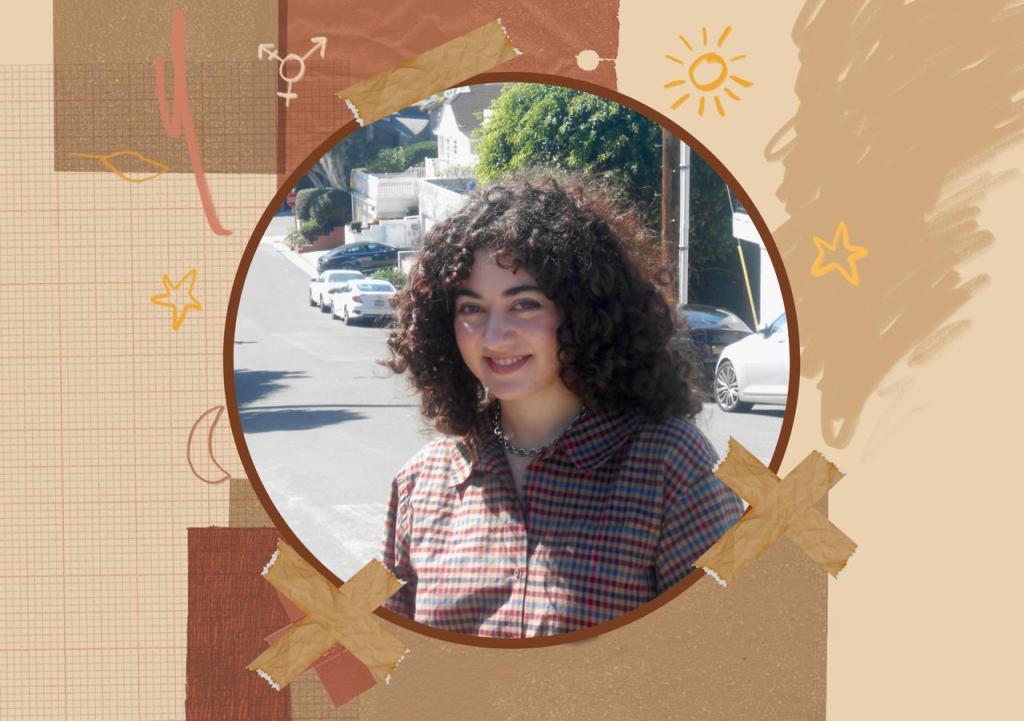
INDIGO: The very lovely guest for today’s episode is Bec Penner. Bec is an interdisciplinary artist from California, utilising film, video, painting, and collage as mediums to explore memory, trauma, illness, connection, and resilient joy. With an interest in disability arts and community care, Bec is currently organizing Rest Fest Film Festival. A virtual film festival and year round gathering space made by and for disabled, deaf, chronically ill, neurodivergent, mentally ill, and or mad folk.
[upbeat drum based song]
LEO: This is Changing the Frame.
[upbeat drum based song fades]
LEO: So, welcome, Bec. Let’s get started by you telling us about yourself and your background.
BEC: Definitely. I’m so glad to be here with you both. I am Bec. I am a non binary disabled Jewish multidisciplinary artist. I’m based in Southern California. I make short films, paint, knit, and I’m currently in the process of putting on a virtual film festival called RestFest. RestFest is a festival by and for disabled, chronically ill, deaf, neurodivergent, mentally ill, and or mad folks.
INDIGO: That’s really cool. I’m so excited to ask you questions about RestFest. So, what made you pursue a career in the film industries in the first place? And were there any roadblocks that you faced when you first started out?
BEC: Yeah. Definitely. I really started by just pursuing my interests, kind of following my interests. I got started in acting, which led me then when I was in college, studied film and media studies and visual arts. And it was really the in classroom studying of films that got me into filmmaking eventually. I just really love films. I was just amazed by them and got really excited. And when I watched films that I hadn’t seen for the first time that were more abstract or experimental, it was really inspiring to me to make my own stuff because with my neurodivergence and neurological conditions and all that, I just can’t think linearly. And so I felt like I couldn’t make films because I’d only seen traditional narrative films. So watching these more abstract films, which I can give you some examples, but they really like were freeing for me. So that led me to that. And I just followed that, did production design, stuff like that, which got me to here. Yeah. I definitely faced a lot of roadblocks. There’s one that I think was the hardest, which was just getting started. I came into it feeling like I wasn’t creative enough. I wasn’t talented enough. And so I got into a head space where I just said I couldn’t. And so I didn’t even try to make work. Like I didn’t want to show myself that I was bad. I guess like I couldn’t face it. And I was really lucky to have a professor and a partner who gave me that motivation and really instilled that confidence in me. So I got to try and I still get into those places where I feel like I can’t make anything. But they do pass, and once I’m in it, I feel focused and like I can do it.
LEO: I’m really glad they do pass, because you make very beautiful stuff.
BEC: Thank you.
LEO: I really love how there’s like, a lot of queer people within experimental filmmaking and also a lot of neurodivergent people within experimental filmmaking. There’s like a huge overlap and it makes me really happy. So yeah, very excited to get into talking about your films. We’re going to talk a little bit about how you shoot and the type of footage that you use. We noticed that you shoot with both digital and film and you also use archival and found footage in different films, depending on what you’re creating. And I wanted to ask you about Rivky, which is a short film in which you explore memories lost to complex PTSD. And you used a very specific type of footage that you found. What was it like to work with the footage you picked? And would you tell us more about the creative decisions behind the film?
BEC: It was really hard working with the found footage. And because of the PTSD and the trauma, from my childhood and onwards, there was such a distorted memory that I had going into watching the films, that when I watched them, it was like, I didn’t know that person. So it was really scary and it was really painful to watch. And it actually ended up tangibly changing my life. Like I made really big life decisions that I wouldn’t have made. And I think that’s. I don’t know. It’s kind of dramatic, I think, but the power of filmmaking, I think, is, is pretty amazing. But the film is about that pain in watching those videos. Originally, I wanted to make a film about intergenerational trauma, because my grandmother was a Holocaust survivor. And that did end up in the film a bit, towards the end. I include her singing a song to me in Hebrew, which was actually from the home footage. It was the day I was born. She was holding me and singing that song that I think her grandmother sang to her. So it’s really beautiful. And I do still want to make more films about intergenerational trauma eventually. The film was my capstone for my BA. So, I worked with an advisor who I’m so inspired by. She’s amazing. She, her name is Karen Yasinski, and she’s an artist and filmmaker. So, I was really excited to work with her and she gave me a lot of guidance to really get out of the box and be experimental and use multimedia. She uses a lot of animation in her work too. And she had me watch a lot of films that were inspiring, one is- are films by Sadie Benning. I don’t know if you’ve heard of them. They’re non binary as well. And super cool. And made films when they were a teenager in their bedroom. And got into the punk music scene as well. So just a very cool person. And I’m glad I was introduced to their work by my professor.
INDIGO: That’s really cool. And how was it like working with like different mediums?
BEC: It was… it elongated the process. But it was nice. I love the act of animating. I used hand drawn animation, so it was frame by frame. And for this film, it was mostly, some not, but mostly rotoscoping, which I loved. And it, the idea, because I was mostly rotoscoping from the footage, both the unedited footage, and most of the film. Like, you can’t see the footage, it’s very abstracted, it’s very obscured, you can’t really see it. So I include some rotoscoping of some footage that you actually can see more towards the end.
INDIGO: We also noticed that memory is a recurring theme within your creative practices, which is a theme that you explore quite in depth in your latest film, As One. What entices you about memory and how did you explore that connection to memory? Within As One specifically.
BEC: I think memory is interesting to me, especially because of like my ADHD and illnesses and PTSD, that it’s very distorted. And I think that I turned to memory as a starting point in all of my films, my most recent films, at least. And then I think memory in exploring those memories, take me to new directions to explore different things. I think in a lot of my films recently. For As One, it is, it started out as mostly being about memory and time and how those work together and both trying to understand time and memory, which are these huge abstract concepts that don’t make any sense, which I love. I love things that don’t make sense. So I think that’s a big part of it. But in As One specifically, I’m rambling on about those two concepts and I get to a point where I start talking about grief and I think that by the end that’s kind of what it’s about. It becomes this desperation for this loss not being real, which my grandmother passed away in the end of 2022 and it’s the biggest loss I’ve ever experienced in my life. And so trying to grapple with this idea of is time linear? Is it cyclical? Is it not even real? Are memories everywhere all around me? And so, if that’s true, then maybe she’s not gone. And all of those ideas are a big part of it. Exploring the memory and time and all that.
LEO: That’s very beautiful. When you were talking about the song in Rivky being the song she’s singing to you on the day you were born. I was tearing up a little bit because I really, I really enjoyed that bit of the film where the audio started very distorted and then the clarity came from that song and the fact that you’re looking into your connection to your grandma through filmmaking is very beautiful. I feel like it’s very, a very caring way to explore it and I really enjoy it. I would like to talk a little bit about your narrative fantasy short film, which is called How to Care for Strangers. It’s a film about growing up, self discovery and connection, and you wrote and directed the film alongside Carver Bain. And you also produced it as you’ve told us most of your other work that we have seen you’ve made by yourself. So we would like to know what the collaborative process was like in this instance. How was it like to write and produce with someone else as well?
BEC: It was a very special project for me. It’s the, it’s kind of the first thing I made… I was making little stuff in, in classes, but I, Carver is now my fiancé, and we met shortly before we started working on the project. So it was this thing that really brought us together and came from that relationship. And so it’s really special in that way. And Carver’s predominantly a writer. So he started out with the writing and I was really into production design at the time. And so we came together in that way, both like bouncing off ideas. And we really threw out the idea of being stuck on labels of roles, like he’s the writer, I’m the producer. It was like, okay, that doesn’t matter. We’re just making something together. We’re, we want it to be the best it can be and we both care so much about this project. So I ended up kind of squeezing into the writing side of things because I got too excited. He wrote the first draft or the first few drafts and then I got in and did the following drafts. Yeah, it was really fun and even on set we were able to break up the roles because it was a kind of big production. And we needed that extra support, I think. Like, I think it really worked out that we had each other for that purpose.
INDIGO: That’s really sweet.
LEO: Also love that you’re partnered and in love together now with the person you made this with. It’s very sweet. I really like the aspect of breaking apart roles within filmmaking, because I feel like when you’re an individual filmmaker, you end up doing a little bit of everything and then being able to do a little bit of everything collaboratively feels very sweet as well. That being said, though, what kind of stuff were you doing as a producer for this project?
BEC: Yeah, a lot of things. I think a lot of administrative stuff. I worked on pulling the team together. which ended up being about 16 people. Really all amazing people, I’m so grateful. And I was scheduling auditions, figuring out the sets, where we’re gonna shoot. The budget was a big thing, fundraising, keeping everyone, like, on track, in pre and post especially. Things like that. And then on set, actually, I had a goal, as the producer that I wanted to subvert the auteur idea, because I think something special about filmmaking, which I can’t do right now because of the pandemic that I’m making stuff for myself, that it is this collaborative thing. And I think everybody on set has a creative voice that often is not listened to, like not valued. And we brought everyone on because we believe in them, we trust them, we respect them. And so I wanted everybody to feel like their creative decisions and ideas were heard and mattered. And I think it created a space that felt really supportive and, I don’t know, united. Yeah.
LEO: That’s very nice. Speaking of creativity within the set as well, something that really struck me from How to Care for Strangers was the dream like scenes. I don’t know if they were set in, like, a dream. that the main characters were sharing, or if they were both in a liminal space somewhere, but the feel of the set that you filmed in was very magical and, like, fantasy like, that I really enjoyed it. How was it to, how was it like to set up the space for filming? What kind of props and stuff went on to creating the space.
BEC: Yeah, production design was central to the development from day one. We had a lot of ideas about what we wanted, specifically the dreamlike space to look like. We called it the house, but it’s, you know, whatever you want to call it. Not. real life. And we got to work with a production designer who became a friend and she’s amazing. Her name’s Vlada Dyecheva. So she worked with us to like realize our visions and also had her own amazing visions. The last set or the second to last set where it’s the bedroom with the clouds, like that was her idea. So good. The way that we built the sets was beforehand, we were doing a lot of thrift shopping and eBay searching and asking friends if we could use their tables and chairs and things like that. And then we were able to rent a soundstage through our university, which was very lucky. The university has a film centre that they share with the local art school, so.
INDIGO: That’s really good.
BEC: Yeah, it’s really nice. So that was a big, a big win and they had flats, like big pieces of wood, you know, to paint and put together. We had three and a half sets. And because we shot. in the real world too. The days that we were shooting in the real world, Vlada and the art PAs were setting up the sets on the soundstage for the next day. And we didn’t shoot in multiple sets on the soundstage in one day. We shot for, I think, a whole week. So at the end of the day, there was time to create the set for the next day. And it was kind of that flow.
LEO: Also, like, kind of dominoing into the next step of the project. Yeah. Working with a short period of time, it’ll lead you to do stuff like that. I just, I just thought about a question. If you were also directing, what kind of directorial choices were you getting up to? Were you directing actors and the scenes and everything? What was it like?
BEC: Yeah, Carver and I both have an acting background. That’s actually how we met, in a play together. Classic. Very sweet. So it was pretty, uh, important to us, working with the actors. So on set and even before, we did a lot of rehearsing with the actors and ended up kind of changing the script to match them. So they were really prepared and, but on set we were working with the actors. What else? There was a lot to do. I feel like I blacked out because it was so busy, but also working with the cinematographers and the sound and all that, just kind of keeping things together. Yeah, there was a lot going on. I think that’s why it’s hard to remember. There were so many moving pieces, even just helping to set up the sets and kind of move things around and reset things between takes and a lot going on.
INDIGO: I love hearing about film production. Yeah, I just, I just love film so much because it’s such a collaborative process, like you were saying before, and any projects that I work with, I really like working with like other queer people, other disabled people, and it’s just nice getting ideas and bounce off ideas. So I love film because of that. It’s very clever. So we had another question about a different film of yours called Carry Me In, which is a non narrative 16mm personal essay film in which you talk about your connection to insects and how it has developed through the years from your childhood fascination to your development of late stage Lyme disease as a young adult. What was the creative process behind Carry Me In like? And did you write the script or did you film it first?
BEC: I was in a class actually that was a 16 millimetre personal essay film class with one of my favourite professors. And he was very hands off, like just his whole thing, which I love, is helping us realise our goals, not really us meeting his expectations, you know, so it felt like my own project, not like a class assignment. I wrote the script first, it got revised a lot even after, like during the actual editing process, but I did write it first. I had a lot more written than I included. It was really exciting because I had just been diagnosed with late stage Lyme around that time. So it was really in my head and like. It’s, it’s a, yeah, very strange thing and I have a close friend who had been dealing with it for many years. So I got to watch her journey and there were a lot of feelings around it. And I was misdiagnosed for two years. So it was like an exciting thing to know what was going on. But also it’s such a complicated illness and a lot of gaslighting. People don’t believe in it. And I don’t know, not a good situation. But then remembering. That it is a tic thing, that it involves insects, which, because I’m like thinking about my body, I wasn’t thinking like, oh, this tic, like, bit me and now I’m here and, you know, whatever. But when I did think about that, I remembered about all these. experiences and interests I had about insects. I, I was really into insects, like, I don’t know why. I just thought they were so cool and so interesting. So it did, it, it brought up this really complicated feeling where I’m like, like, I should hate insects. And I don’t love them anymore. And is that why or what changed? Again like something that I still I’m trying to understand. And I think that’s something that guides me to make something. Once I was shooting, I had to be shipped a 16 millimetre film camera across the country because I was living at home because, I moved back due to the pandemic and it’s the other side of the country, so very far and because it’s a film camera that is so rare, there were problems that came up. It broke and I was by myself. so trying to become like an engineer. in my house with not any experience or knowledge in that. It was really scary, but really fun actually, and gratifying.
LEO: Solo filmmaking will do that to you. You end up learning so much about everything else as well.
BEC: Yeah, it’s so fun. I love shooting on 16 millimeter or like any film and maybe that’s part of it that it’s so complicated and so many things could go wrong.
INDIGO: And that’s part of the process. Yeah, the things going wrong and I just love film because it’s so tactile and you can actually play around with it like physically, which is really fun.
BEC: Yeah, I love that.
INDIGO: Do you wanna talk a little bit more about how you found 16mm film and being a cross country, like how was that like with your professor and like that process of creating the film?
BEC: I had taken one class prior in person, on 16mm. This was kind of like the next step, I guess, like once we’ve taken the introduction. So I did have some guidance and I knew how to use it. Luckily, oh my God, if it was introduction. Like this. It’s horrible. It’s also, they’re so heavy, these cameras. Luckily, I had Carver with me. There are some hands shown in the film. Half the time, there is a gloved hand, and then there is a non gloved hand. The gloved hands are his hands. The non gloved hands are my hands. So, yeah. He was a great support during that. And then, yeah, I had to ship the film across the country too, because the film lab. was in Washington D. C. that the school uses and then they shipped it back to me. It’s like very not environmentally friendly and doesn’t make sense. But my professor was amazing and he got on the phone with me. He sent me emails of like diagrams about the inside of a film camera and drawing arrows to things. And so it was great. I, it was a bonding experience. I really love him. So it went well.
INDIGO: That’s really good to hear. And also in terms of your scripts, they’re very reflexive. How’d you go about writing the text for your films?
BEC: It’s entirely a stream of consciousness. Like, I won’t go into writing thinking this is going to be in the film. I’ll just write pages and pages. And I think, like, it helps me learn things about how I’m feeling. And it allows me to go on tangents, which is natural for me. And I don’t have to be like, this is how it’s supposed to be. And I need to make my brain fit these ideas and whatever. It’s like let’s just go like ramble on and then pick things out from those stream of consciousness writings for the film because the films I make are so short.
LEO: Nice. I like that. I tend to make shorter format films as well and Writing for them, to me it’s very interesting, I think, right after I’ve started filming and stuff like that, interestingly. So I’ll pick up an idea and then start developing the writing to go with it. So I’ll be like, why am I filming this specific thing? What is it that I’m feeling? And then I develop. So it’s very interesting to hear that you have like, Pages and pages and pages of stuff going on and like, going on tangents and everything, I, I enjoy that. Stream of Consciousness feels very fitting for your writing and it’s something that comes across in, In My Hands as well, which is the short film you made, where we can just see you hanging fibre arts and you’re talking about childhood, gender and coping and the fibre arts themselves. Would you like to tell us about the context for this film? How it was made? And there was an exhibition that it was on. Would you also like to talk about that?
BEC: Yeah, I can definitely talk about that. It was really like the start of the pandemic that I was working on this. Carver and I were living in my parents house, it was a very cramped, very stressful time. And I had just come back from studying on exchange in London, where I was making pretty large scale paintings. And I wanted to continue that when I got home. And then I found myself living just like in a room in my parents house and couldn’t do that anymore. So I originally got back to knitting because I wanted to convert the paintings into a smaller format, and so tried doing that with knitting. But doing that brought up all these feelings and memories, again memories, about how every time I’ve turned to knitting in my life, it was during these moments of crisis and Trauma and things like that, kind of subconsciously, I guess, like I hadn’t noticed that pattern and as far as the other feelings that came up that I talk about in the film, like gender, I think it came up in two ways. One was that the start of the pandemic really was. a big turning point for me in terms of understanding myself in terms of gender. I think the isolation allowed me to see myself instead of seeing myself through other people and I was able to put labels to, you know, how I was feeling, which was really transformative and exciting and affirming. And it was interesting thinking about knitting in terms of that, because one, I talk about how I learned to knit in school as a child and only the girls were taught how to knit, which is so weird. I really don’t understand what they were thinking. So there’s that. I felt really isolated. I wasn’t comfortable in that environment. And there’s the general stereotype of knitting being this inherently feminine act, which with those in mind, like knitting became this. act that felt dysphoric, which was awful, because it’s fun and relaxing. And luckily I was able to change that mindset, like not the dysphoria, but like disconnect knitting from gender stereotypes. And since I’ve actually gotten really involved in the online global knitting community, which is so sweet, like the most wholesome group of people. And it’s actually very queer. So it’s a really cool space. So yeah, then I made the film to kind of bring all those feelings together, utilising the tapestries that I made. And I had a professor who saw the film and recommended that I submit a still from it to this exhibition. And the exhibition was cool. It was, again, like, start of the pandemic. The goal of it was people from all over the country, I believe, I’m not sure if it was global or not, create artworks and hang them up for the neighbourhood to see.
LEO: I love that.
BEC: Yeah, it’s so sweet to bring art to the community and like hope and beauty. So I left those tapestries up on my balcony for a little while and it was part of that big community. exhibition.
LEO: That’s absolutely incredible, yeah.
INDIGO: I used to work at a cafe and there was a knitting group that came in every single week and they were the sweetest people. They would just get tea and knit for hours and hours.
LEO: I feel like I should start doing that.
INDIGO: And they were very queer as well. It’s in Glasgow. I don’t know if they have a queer
LEO: I’ll join them. I’ll find them and I will join them. I will bring my crochet hook to the knitting party. It’s good. I also, I also had to go through like those feelings of disconnecting fibre arts and their femininity or like imposed femininity from dysphoria. So like I stopped crocheting for the longest time and I’ve only just recently picked it back up and it’s the best thing ever for the neurodivergent brain to just be doing something while you do things, yeah.
BEC: Yeah, 100%. Yeah, I recommend it. It’s very nice time.
INDIGO: And also talk about other projects of yours. There’s not necessarily a film, but a collection of them. So, as you said before, Restfest is an upcoming virtual festival exhibiting short films and video art created by filmmakers identifying as disabled, deaf and hard of hearing, chronically ill, neurodivergent, mentally ill, and or mad. Why did you decide to create a festival like this? And would you be able to tell us about the idea and the setting up stage and pre production for the festival?
BEC: Yeah. RestFest is something I’ve been looking for just as a disabled artist myself. Something that is focused on the community around film. Disability is something that’s super central to my identity. It means a lot to me. And I’m really inspired by other disabled artists. I think the art made is incredible whether it’s writing, film, paints, you know, anything. And I think that art making and art engagement has this power of being unifying and combating the loneliness and isolation that’s so common for chronically ill and disabled folks. So that’s something that’s important to me and a big motivating factor. I’ve been wanting for a long time to create some kind of disabled art space and I imagined it as a sort of gallery or some kind of in person situation and I thought, you know, that’s far down the line. I can’t buy a space right now. That’s not, you know, something that is going to happen, but making this virtual festival and community space felt accessible and it’s been amazing. I think something that’s really central to RestFest for me is that it’s like, I was saying, it’s for the community. So, in contrast to, there are a lot of festivals that I found, festivals and film opportunities for disabled folks. I use disabled as a broad term, so I don’t have to say so many words, but it includes all the words. A lot of these spaces require the filmmakers to make films about disability or illness. And I think that’s definitely needed and valuable, but that’s not the goal of RestFest. Like, the goal isn’t to educate the non disabled, it’s to create this space for us. And everyone’s invited to attend, and I hope everyone does. But it’s really freeing, like, I want to celebrate free creative expression. Instead of putting us in a box, you know.
INDIGO: I feel like working for queer film festivals, I feel that a lot. I identify with that a lot, like at least for SQIFF, like 90 percent of our team is trans and disabled and I feel like Working with other queer and disabled people is always so good and like you were saying, creating a community that doesn’t necessarily showcase films just about queerness and disability, but films made by us is really important and I can’t wait to attend RestFest. I know you’ve already talked a little bit about this, but what are you hoping to achieve with RestFest? Like, what are your plans for the future as well?
BEC: The goal is definitely to celebrate disabled art and create community. And part of that is I want to create year round gatherings as well. And we actually already started a film club in collaboration with The Remote Body, which is led by Char Heather. And it’s so fun. We had our first meeting a few weeks ago, yeah. Please join, it’s a lot of fun. So it’s going to be like a monthly thing, but we’re also going to have workshops and talks and things like that. So another thing that I’d like to happen is to bring in other people into making films. Like I think anybody can make a film. I think everyone’s an artist and having that motivation and a little bit of guidance, I think is really special. And I want to provide that. And I’d love to foster collaborations between other artists. I think that’d be really amazing. And I also want to expand Rest Fest eventually to all art mediums. I think that’s a little bit down the line, but that’s another goal.
INDIGO: For the filmmakers group, how often, when do you meet, where?
BEC: Yeah, the film club, we meet every… right now, it’s every first Thursday of the month, depending on people’s availability. The day might change, but it is monthly. It’s virtual. We’re making sure to accommodate timing right now for like from the West Coast where I’m at in the US to, I don’t know, Central Europe maybe, kind of depending on who wants to join. So you can sign up through our website. There’s like a little sign up for your email and you get information. And we watch films by disabled people. We talk about them and talk about our feelings. It’s very, it was so chill and so lovely. Everyone just, you know, understanding each other and speaking quietly and gently. Yeah. It was a really good time.
INDIGO: That sounds amazing. I’m definitely going to sign up.
LEO: Yeah. Indigo, we’re going to have to attend. Oh, I’m so excited to see you there. That’s very cool. I find that for me, mostly since the pandemic, I found more and more comfort in online spaces. And it just makes me really happy that there’s a community of disabled people that obviously it’s a bit harder for People like us to just meet in person all the time, and finding groups and pockets of joy in the internet is just so lovely. I love, I’m very excited about RestFest. I’m slowly plotting something for it as well, which will be very cool. but yeah, we’ll see, we’ll see what happens.
BEC: I’m so happy to hear that.
LEO: Yeah, talking about festivals, right? So let’s chat a little bit about the festival circuit and awards. You’ve had some of your films screened in several film festivals. You’ve been nominated and your films have also been awarded. How do you go about applying to film festivals?
BEC: It’s a long process, it’s something, there’s a technical aspect to it that requires a lot of organising, which is kind of my favourite part, I love spreadsheets, and
INDIGO: Same, same, I love spreadsheets.
BEC: Which has been great for RestFest too.
INDIGO: Yeah, I can’t, I can’t live without a spreadsheet, I feel like it’s so good for everyone on the team, you know?
BEC: Yeah, yeah, I love it. There’s so much you can do on a spreadsheet. So, it’s a lot of that, researching festivals, like, what would fit the film. But, at the end of the day, like, it’s hard, like, it’s expensive. Which, I’m trying, you know, with Rest Fest, there’s, it’s free, there’s an optional, like, donation. But, I don’t want to have that barrier. Because with, like, you make films, you lose money, most of us, you know, and that’s like, that’s not okay. But yeah, it’s like, it’s mostly rejection, and I think it’s important to go into it, assuming there’s, you know, you’re gonna get rejected, but I’m a big believer in shooting your shot, like, I think you have to go for it, and you could feel like your film is amazing and not get accepted, you could feel like your film sucks and get accepted. Yeah, you just never know. But it is nice and I think it’s a, it’s a cool opportunity to get your work out there and meet other people. I’ve mostly not been able to attend in person because of the pandemic and, being immunocompromised. But it’s still really exciting and as far as nominations and awards and all that. It’s shocking because I don’t even expect to get accepted into the festivals, so it’s really an honour, but it also is at the end of the day, like, you keep making the work, and I think for me the coolest thing about the nominations. is looking at who else is nominated in the categories because they’re people who I am so impressed by and to see me like with them in that category is like just very encouraging.
LEO: I had a film screen at SQIFF and I lost my mind. Because of it, it melted my brain. It was paired up with two other documentaries. And it was just wild. It was just very wild to be able to watch my short, very, very short, short documentary with other films that I aspire to, basically. So, I understand the feeling. It’s huge. It’s very huge. Do you have any specific films that you would like to mention that they are awarded and how like the awards receiving situation went?
BEC: Yeah, the films How to Care for Strangers was awarded by Fort Lauderdale International Film Festival and Los Angeles International Underground Film Festival.Yeah, it was very special, but it also was super chill. Like, it didn’t feel like a huge deal. It felt like a shock, but the actual moment like of receiving it, I think like it feels like with all achievements, it’s this moment that’s really exciting. And then like an hour later, the feeling is gone. So it’s, it’s hard to. Put a lot of weight on to that kind of thing.
LEO: Fair. Very fair. I feel that, actually.
INDIGO: Talking a little bit beyond filmmaking, we know that you also do knitting. Are there any other creative practices that you’re interested in? I know you’ve mentioned a few during the discussion today.
BEC: Yeah, there are a lot. That I wish I had time for. I will, I’ll tell you about them. I, I’ve been trying to get into cyanotyping for a while. I think it’s amazing. I think it’s gorgeous. I have… carver for my birthday or some holiday got me a kit, like, years ago now, and it’s been sitting on my bookshelf because I’m like, I need to have a good idea. But, again, like, that’s not helpful. Like, I need to just do it. So that’s one. I Did a little bit of animation directly onto film, like scratching and painting.
INDIGO: Cool.
BEC: And it’s so cool.
INDIGO: I really enjoyed that.
BEC: Yeah. It’s so nice. It takes so long, but it’s, it’s fun. Like, that tactile nature of it, like what you were saying.
INDIGO: Yeah. I’ve only done it on 8mm film. Um, I don’t know if, have you done it on 8mm or 16? I think it was
BEC: 16. Eight is so small.
INDIGO: I know, that’s the thing, like, with 16 you get to work a bit more, I guess. But yeah, with the 8mm, I was just drawing stars and other stuff.
BEC: Yeah, I, I really was just like, I had an exacto knife, just like scraping things and like, taping things on. I was, my roommates brought stuff to me. They were like, Oh, do you want this thing to like tape onto your film? Like, it was very cute. But it was just a, like, an experiment, it was a learning experience, not a finished product. So I’d love to try that again. I also, I like, prefer making non narrative stuff, but I like being on set, and also I did some screenwriting, like, classes. And I think they’re so fun. I think that it brought out more of like a playful side of me in terms of creativity than in my personal stuff. In a, I was in a like TV writing class and I wrote a pilot about a non binary alien rock star
LEO: I love that.
BEC: And it was so fun. Like, yeah. It’s a good time. So something like that, I think it’d be fun to revisit and do more of that kind of thing eventually.
INDIGO: That sounds amazing. I really want to watch that.
LEO: It’s very exciting about the film scratching stuff for me to hear right now, especially because after SQIFF, I’ve been thinking about it non stop. There was a workshop during SQIFF this year, and this really cool person called Autojektor, that’s her artist name. She does All her films by scratching film and by like distorting it and she puts all kinds of weird stuff on it And it just looks really cool. And yeah, she did a workshop for SQIFF and I’ve just I’ve never done anything like that before I just can’t stop thinking about it.
INDIGO: I’ve done it twice with her and I just love what she does. She works a lot with like trans porn And like scratching the faces out of people. It’s very interesting and I really like her.
BEC: That’s so cool. That sounds amazing.
LEO: What advice would you like to share for people who are just getting started?
BEC: I think I have a few things. One is to really just give yourself grace. Like making art is so hard and it’s such a brave act. And the self judgement comes up, at least for me, I think most people. And it’s just not helpful, like, I think the solution is to just notice the judgement in yourself and validate it, like, it’s there, it’s normal, and then let it go, because it’s usually inaccurate anyway, like, it’s not helpful. And something I like to do is like, When you’re watching a project of yours, instead of asking yourself, is this good? To ask yourself, is this what I want it to be? Like, am I fulfilling my vision? Because that’s all you want. Like, you know what I mean? And it feels good. Like you want to make something and you watch it and you’re like, that’s what I wanted to make. Then it’s done. Like, you did it. You did what you set out to do. Second advice is just to document everything. I think it’s something people say, and I think it’s so valuable to just write down every, like, weird thought you have and take pictures of little things just on your phone or record sound, things that you notice. I think one, like, noticing things around you and in your head is, it feels good. It helps you be present. And I also I look back at this stuff when I feel stuck to think about what I want to make. And that’s really helpful to have a jumping off point. And also looking back at like the pictures you take or the videos or audio, you can see patterns and understand what you’re interested in and to understand yourself better. Is helpful when trying to make things.
INDIGO: Those are really good advices.
BEC: I’m glad.
INDIGO: I’m definitely taking them forward, especially the first one. I think like, there’s been so many things that I’ve done that I was really happy with myself. And I just, sometimes I don’t share it with people, but I was really happy with like doing it. And I think I did accomplish what I wanted to do, even though it wasn’t like. The best thing in the world. I was very happy with what I did. So I, I really liked that one.
BEC: I love that. That’s amazing.
LEO: I immediately, immediately, immediately next to my film film notes for whatever it is, I’ll make out the one I was like, Yup.
INDIGO: Yes. Yes. Are there any new projects on the horizon that you would like to tell us?
BEC: Yeah, in the very early stages of working on creating an audiovisual, like, ongoing correspondence project with my very talented filmmaker friend, Lukas Mackinney. They live on the other side of the country and it’s hard to stay in touch. I think both of us, like, I don’t know, it’s hard to stay on top of texting and you get busy with calling and all that. And just like staying on making things consistently is hard with being busy and all that. So I think it’ll be a really fun way to stay in touch and also to be making a project together and back on collaborating, which I want to do.
LEO: That’s very gorgeous. Again, epistolary related stuff. 10 out of 10. Always welcome in my book. I love things that talk about communication and like long distance and stuff like that. It’s very beautiful. So we’ve made it to the end and this is the last question we ask everyone. Do you have any media? And that can be podcast, books, films, tv shows, video games, music. That you would like to recommend to our audience. It can be queer. It doesn’t have to be queer. It can be by disabled artists, if you want to stay in theme, but whatever you fancy
BEC: recommending. I have a couple, a mix of queer and non queer. I will start with Sex Education because it just finished. Did you watch it?
INDIGO: Yeah.
BEC: Did you like it? I thought it was so fun.
INDIGO: Yeah, I think the last season, I hope, I wish there was more episodes, because I feel like some things were a bit rushed, but I thought it was really great, like, how queer it was.
BEC: Yeah.
INDIGO: This new season and it was great to have a T4T couple.
BEC: Yeah.
INDIGO: In a TV, in like a mainstream TV show that I’ve never seen like I’ve never seen that happening before. Yeah i don’t know it was just really good
BEC: Yeah.
LEO: I’m not finished with the fourth season so please no spoilers.
INDIGO: Okay.
LEO: But I I’ve I’ve. I think I’m like on like episode four and I’m just I’m loving I’m loving the visuals a lot, I quite enjoy the, the college they’ve gone to is totally surreal, but I’m vibing with it so hard.
BEC: I love it. And the way, I think, especially in the last season, they have so much intersectional representation in a way that I’ve never seen before, like you’re saying, and it doesn’t feel like, tokenism, like they’re trying to, you know, I don’t know. I think so often it’s like, oh, you know, like, we have a trans character, look at us, or whatever. But it’s like, everybody has some kind of, you know, like, intersectional identity. I mean, everybody does, but yeah, I just think it’s so well done. I cried, like, multiple times. Yeah, whether it be like the disabled storylines or the trans storylines, like just so beautiful and able to mix like playfulness and drama. I think they do that really well.
LEO: I love Eric as well. Let’s just give it up for Eric. My favourite of all time.
BEC: A film. I really like that I saw it at London Film Festival in 2019. It’s called This Is Not Berlin. It’s by Hari Sama. It’s a Mexican film. I just loved it. Like it was, it really stuck with me and I didn’t know anything about it going in. It’s autobiographical and it’s set in the 80s in Mexico and within, like, a very queer, punk, like, art scene. And so it’s fun in that way. And because it’s autobiographical, it feels so honest and real. And I think you can tell the difference, you know?
INDIGO: I love finding films from film festivals. Because you get to see so many films that, that you wouldn’t see anywhere else, and you get to meet different filmmakers, and yeah, I don’t know, I just love film festivals so much, so it’s really cool that you got to see it at London Film Festival.
BEC: Yeah, I’m so grateful that I just happened upon it, like that. I feel really lucky. It really, like, sat with me. I thought it was so well done. As far as more experimental stuff, I really love the Swedish art duo Nathalie Djurberg and Hans Berg. I think it’s a little harder to find their work online. I was looking up, you can find YouTube videos that have clips of their stuff and a lot of, like, interviews with them, like about the making of their work. They collaborate on making these mostly claymations installations. And it’s really interesting, like big trigger warning for trauma of many kinds. But when I’m in that headspace where I feel like. I want that catharsis and, like, representation, I guess. Like, they create things that are so grotesque in, like, claymation, you know? Which, like, claymation’s like, oh, is it, like, playful and, like, youthful, but, like, they turn it into something that’s, like, honestly like gross like it’s hard to watch but it’s so good like I love it. I think it’s amazing
INDIGO: I love claymation. I’ve always wanted to learn more about it So maybe something i’ll explore in the future because I just find it any type of animation and stop motion I just I want to learn more about it, but it’s a very long process So, I’d have to have some time to, yeah, take some time with it, which is nice.
BEC: It’s a cool, like, mix of sculpture and film, animation, like, stop motion. I think that’s really cool.
INDIGO: Are there any other, like, media that you would like to recommend?
BEC: Yeah, honestly, so many things, but I’m gonna end on one that’s, like, a more broad recommendation, which is the website /app called No Budge. It’s a, it’s a streaming platform, but it’s all low budget short films and they just have really cool stuff on there. I think it’s really inspiring and just most of it’s free. So that’s nice. Yeah. I learned about a lot of new filmmakers and learning the learning about shorts. Like, you know, there’s so much more, it’s so much more accessible to watch features. But the process of making a short film is so different. So to be able to watch films, I think is really helpful and really inspiring. And they’re just really good.
INDIGO: I will check it out. I’ve just downloaded that app. I don’t know if you know of the Otherness Archive.
BEC: No.
INDIGO: They are on Instagram, but they have a website as well. They just started in January this year, but they are mostly an archive for like trans and Queer films and they’re all free and you can watch them online. They’re really good. Wow. If you want to watch more short films.
BEC: Thank you.
LEO: No Budge sounds very good. It’s really good. We, I didn’t know about No Budge either, so that will be good for us as like a place to find other people to collaborate with as well, I think.
BEC: Yeah, some of my favorites that are the more like abstract things that I watched early on that made me feel more confident and intimidated, but mostly confident to start making things. Were Daisies by Vera Chytilová. Amazing, huge. And as a production designer, like incredible. Persona by Ingmar Bergman, one of my favourites. Very queer coded. I love Solaris by Tarkovsky. Really beautiful and strange. And then, as far as like, shorter, like old, shorter experimental films, I’d recommend the short films by Maya Deren, Stan Brakhage, and Norman McLaren. You get kind of like a wide range there, I think, of different stuff. Which is fun. Like McLaren does like more animation and yeah, it’s nice.
LEO: Nice, nice, nice. So many good recommendations.
INDIGO: Thank you so much for joining us today. Like it’s been so lovely to meet you and talk about your work and yeah, I’m so excited for RestFest and the film club. I’ll definitely be joining and it’s been really lovely to chat to you. So thank you for joining us.
BEC: I’m so happy to meet you both and to be here. And I’m really excited to see you at the film club and get to know each other.
LEO: Yeah. Thank you for joining us.
[upbeat drum based song]
INDIGO: This conversation with Bec was so beautiful. It was very special to have them join us in the podcast as a guest.
LEO: Bec’s work is listed on their website, becpenner.com. Restfest Film Festival is currently open to submissions. Make sure to follow Restfest on social media to find more information about upcoming events and film submission guidelines. The festival’s Instagram handle is @restfestfilmfestival, and the website is restfestfilmfestival.org.
INDIGO: These links will be on the episode description for your convenience, and you can always find more via our Instagram, where we tag interviewees and share their media recommendations.
LEO: Thank you so much for listening to this amazing episode, and stay tuned for our following episode next month.
[upbeat drum based song fades]
 Changing The Frame
Leave a comment