[upbeat drum based song]
INDIGO: Hello everyone and welcome to Changing the Frame. We’re your hosts. My name is Indigo Korres and my pronouns are she and her.
LEO: My name is Leo Torre and my pronouns are he and him.
INDIGO: Changing the Frame is a podcast that discusses trans and non-binary experiences in the film industries. Every episode counts with the appearance of trans and or non binary multimedia artists in the film industries joining us in conversation about their work. We’re really excited to share these amazing talks and discussions with you all.
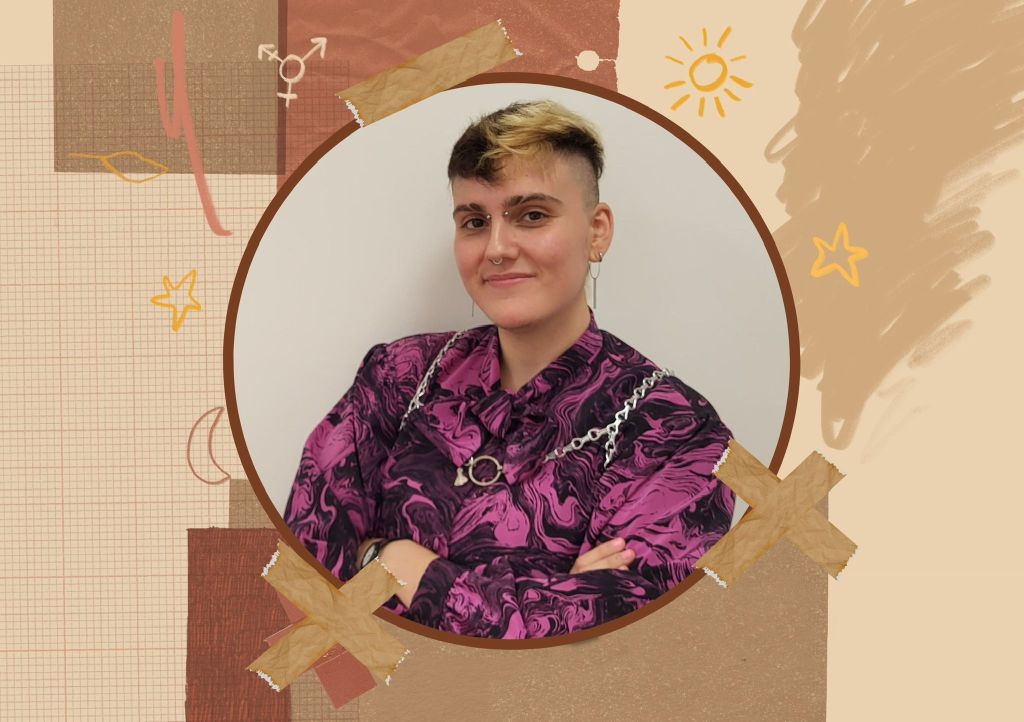
LEO: The guest for this episode is Cande Lázaro Cienfuegos. Cande Lázaro is a filmmaker and photographer from rural Spain. His work focuses on the intersections of queerness and rural life, which has lately taken a specific look into tradition and how to make room for transmasculine bodies within it.
[upbeat drum based song]
INDIGO: This is Changing the Frame.
[upbeat drum based song fades]
LEO: Hello, Lázaro. Thank you for joining us today. If we could get started with you telling us about yourself and your background, that would be great, please.
LAZARO: Um, well, thank you. Thank you. Thanks to you for letting me join and be part of this. Well, my name is Cande Lázaro. I use both names, Cande and Lázaro. Well in Spanish, one is feminine and the other one is masculine, but, anyway, my pronouns are, um, he/they. Um, truly this is the most difficult question, because I don’t know where to start. Maybe I would say that I’ve been living all my, all my life in, in super small villages since I was a child. And I, I don’t know. I grew up most of my childhood and adolescence, like when I was a teenager in small villages, then I moved to Madrid. That’s the, that, I think that this is truly important because it’s the reason why now I’m living, I stopped living in Madrid and moved to a small village again. That’s why I think most of my work also deals with rural life and how to live in the countryside and everything. What else I can tell about myself? Well, it’s difficult. This is like a super wide question, I don’t know how to answer, never.
INDIGO: And what made you pursue a career in the film industries and your interest in filmmaking specifically?
LAZARO: Mmm, I’ve been thinking about this and I really think there’s a difference between film industry and filmmaking, because I pursue a career in filmmaking, not specifically in the film industry. The film industry came later, and it was kind of a consequence, but I didn’t expect that. Like, I, I really only wanted to do cinema because that’s what I’ve, I’ve grew up, uh, being exposed to cinema like every single day because of my, uh, father. He’s like, uh, this kind of person that loves cinema. So I’ve been going to the cinema, seeing movies since I was a child. And, um, I don’t know. Later on, when I was at high school, everybody was like, you have to do medicine, you have to do a career that is, like, important or because of your grades and your marks and everything. But I was like, no, I really want to do this other thing that is just about images moving. And that’s what I want. Um, and then it was kind of an excuse to talk about the issues that I deal with. So, more or less, I don’t know, kind of filmmaking is just a mechanism, a device, a tool that I have to talk about things. But it’s not something that I’m, that I know a lot, that I have a great knowledge about it, or that I, kind of, I don’t know, um, pursue, like, with, with being focused on it, and because I love it. It was just, kind of the way I had to express things that I need to express.
LEO: We noticed that your practice is very focused on the intersection between queerness and rural life. And obviously from your introduction, obviously you’re here in this podcast, so you’re trans and you said that you come from a very rural area, that you came back to the rural areas after being in university. Why did you decide to explore those connections in your film and what other, like, stuff do you draw inspiration from for your films?
LAZARO: I wanted to explore this because I didn’t know how. It’s mainly because I don’t know many things, and I deal with many issues that I know that I don’t know how to express and how to, to talk about. And I, I just need the tools and the medium and the, well, space to talk about it. That’s why I mainly talk about the rural life, because I’m like in between, because I live in a city, but I’m from a village. But I was born in a city, but I’ve lived in many villages, so I don’t know how to put myself in this in between. And also, I don’t know how to kind of locate myself in a place where you are supposed to be a stranger, and you are supposed to be marginalised and everything. Even though that’s maybe not true, but yeah, that’s why I’m interested in how to, because I really think that I belong to this place, but I don’t know how to belong to this place or how to behave in this place. And I don’t know if I’m accepted or not, and I don’t know if I want this acceptance or not. So, that’s why I’m always in this, in these issues. Yeah, but it’s not like in a, I was saying before in an artistical because, because it’s something that it’s, uh, hurting me and I want to, to develop and to try to, um, I don’t know, to make it less painful. Yes. And the other question was? What other, ah, yeah, what other, uh, things
LEO: [What] creative practices do you get inspiration from?
LAZARO: Mostly photography. Also painting. It doesn’t have to be creative. I also get inspired by my mom, daily life, uh, like, normal things inspire me a lot. Language, especially nowadays, inspires me a lot too. Like, kind of, uh, super uncommon idioms or collocations in Spanish, uh, from the rural, from something that my mom only used, or my grandma only used, I also, that also inspires me too.
INDIGO: That’s great. And, um, moving on to your work. I might not say this correctly, Quiero Ser Danzante…
LAZARO: Yeah, nice!
INDIGO: … is a piece that you most recently made for a zine called Aberruntos.
LAZARO: Uhum!
INDIGO: What is this piece about? And how did you feel to develop a visual project instead of a film for the zine?
LAZARO: Yeah, uh, well, this piece is mainly about a tradition in my, in my village, my mom’s village that is called, um, well, it’s usually like a, kind of, uh, Romería, I don’t know how you say it in English. But you dance, travel with the virgin from one place to another. And it occurs every seven years, uh, here in this village. Uh, so there are some guys that dance to the, to the virgin. And it’s only like cis, hm, normally hetero guys. And it’s never been anything else. It’s not because it’s written on some place, it’s just a tradition. And I wanted to approach it from the transmasculine side, on how it would be for me to be this, in the next generation, it would be a person that is a trans guy or an homosexual guy too. Well, these things, how it would be. It was needed to be photographs, because it has kind of a wave. It’s like heavy, and in, in, I don’t know how to express, but it’s like when you see them, they kind of are heavy to you and you have to look at them for some minutes, and that’s something that I wanted to, to approach and to, yeah, to discuss. Also, it was needed to be photographs because it was, it was going to be, um, printed. So I, I had to, there’s no way of printing a movie. So, yeah, it was also something technical.
LEO: That’s so cool. I can understand what you mean about the weight. Cause when I saw them to me being from Spain as well, it, it really signified something and it was quite like, yeah, tradition is very closed off to queer people and, just seeing them felt kind of wild. Um, I saw through your Instagram that you had an exhibition for them…
LAZARO: yes!
LEO: … or something. Would you like to tell us about that?
LAZARO: Yeah, mainly, hm, we did this for this magazine. Then we did like a performance in which I was using again, the typical dress that these people use. And later on, there were some, some pictures that were out of the magazine. So, I wanted to do an exhibition to present all the, like the full footage that I have. Also to bring some other issues that were not on the, on this magazine. It was nice to have them, especially like in Cuenca, because there was, there were many people coming from villages to see the exhibition, and it was so nice because they were telling me like, “oh, I came from this village and I saw your art in your village, and I really want you to be a danzante or a dancer, when you, in two years, and I hope you”, like, they, they were all of them wishing, uh, that I, that I can became a dancer in in the next, yeah, event of this, of this tradition.
LEO: That’s very cool. Um, yeah, a bit in the line with photography as well. uh, we wanted to ask you about Mar(i)cona…
LAZARO: Uhum!
LEO: … hm, which is a piece reflective of your own life, it’s a film that mixes quite a bit of photography into it as well. What was the process of creating Mar(i)cona? What, why did you decide to develop that film?
LAZARO: It was after COVID, so I, I was living in Madrid and I had to make the decision of moving to my home village. And it was hard because I had to go from Madrid with, I don’t know, 4 million people living there, to a place where only, a thousand people live. So, it was kind of super difficult to me, especially because I knew there were nobody queer there, or maybe that I knew at that moment. So, I had all these questions about how happy I was there, and how difficult at the same time, and how isolating. Also how difficult it was to live with my family, and to express my identity at the same time. I had to, not hide it, but it was complicated to express it. And I didn’t have any friends to talk about this in, on the village, in the village, I don’t know which preposition is correct. Well, I don’t know. I had all these questions, and I, I just wanted to express them and to think about my identity living in that place. That was at the same time so familiar and so unfamiliar, like, far away from me, I don’t know. And you see, it’s something that, it’s just something that I, sometimes I have so many questions and I need to answer them, and I do a film, and that’s all.
LEO: That’s, I think that’s a cool way to go about it. You were saying earlier that language inspires you, and the title of this film is a play on words. Would you like to explain what the title is?
LAZARO: Sure! So Mar(i)cona, it’s a kind of a joke between Marcona, which is a kind of almond, and Maricona, which is, kind of, faggot in English. So, I was combining these two words that were at the same time, kind of, what I normally do at the village. There is, going with my family to pick up almonds, and the fact that I’m queer in this space.
LEO: Nice. The film has been to a few festivals. So it’s been in the International Film Festival in Rotterdam. It’s been in Pink Screens in Brussels and, it won a prize in the Sicilia Queer Film Fest and was recently screened at the Euphoria Festival in Madrid as well. How are you finding this reach?
LAZARO: It’s not overwhelming, but it’s surprising, yeah. It’s kind of, how on earth people would like to see this? I don’t know, it’s weird, especially because it has passed like two years from when I, when I did it. Especially because there are a lot of European places interested in it. It’s not like a Spanish thing, but a European. And I don’t know, it’s all thanks to, to the distributor, not to me especially, but the distributor is doing an amazing job with this. And at the same time, it’s kind of strange watching how outside my village and outside the place I live, it’s so welcome, this movie. And in my village is like, my mom still says it’s, I mean, it’s just a movie. It’s not something particularly good or interesting or anything. And there is a photo of, of hands in this movie. There are my grand-aunt hands, my mother’s aunt. And she always says, “oh, my, my hands are going to, to go all over Europe.” It’s the only thing that she thinks when I tell her about this. But it’s nice, I don’t know. I gained, I gained some money, yeah, so it’s nice to have it, uh, yeah, all over these places.
LEO: Have you screened the film or any of your other films in your village or in any other smaller villages in Spain?
LAZARO: No.
LEO: Instead of in big festivals?
LAZARO: No, just in Cuenca. It’s a small city, but it’s not a village. In Cuenca, I’ve screened Mar(i)cona. And I’ve been planning on screening on the village. But it’s something that, I don’t know, I don’t think people there would feel comfortable. I think it’s, it’s a language that I use in the film that is not their language. And I understand that they are not comfortable and I understand that they, uh, I don’t know. I would love to, but I’m planning on doing something with them on the village. Another short movie. But yeah, not the screening this maybe, I don’t know, I’ll have to think about it.
LEO: That makes sense. Sometimes it’s just not possible because of the people who might watch it or anything. So yeah, we were just curious ’cause obviously if it’s made it to so many different places in Europe, but have the people in your hometown seen it, but, yeah, it’s a bit interesting.
LAZARO: Yeah.
LEO: We also really love the photos that you used through the film. And we think it creates a very nostalgic and familial feel. And, yeah, photography has been used to document and archive queer lives for, since, since photography existed, basically. And we noticed that the film is also available in the Otherness Archive, which is an archive of transgender films. How do you find the process of documenting your life through film? Because you also used film for the Quiero Ser Danzante?
LAZARO: Hm, these are questions that I never think about, hm, but it’s amazing because I can think about them now. I used to, not now, because now I think there’s been like a process in which I’m more settled, I’m more in peace with my identity, because all these films have several years, so it was from this, kind of, unstable time of my life where I was discovering my, discovering, no, it’s not the right word. Yeah, settling my identity and trying to put words to what I, I was going through. So, that’s why I document so many things. Now, I, I don’t use the camera that much for, for mostly anything. Because I, I’m in another, in another time of my life where everything is settled, and I have the space to, and the time to develop other things that also are from my identity, but it’s not about being queer, it’s about maybe other things that I, I want to explore. But, I think queer people especially need to document many things. Because there’s no documentation about it. That’s why there are a lot of TikToks about testosterone and hormones or, uh, operation. Like, yeah, like chest, uh, operations, mastectomy and everything. Because we need, we have the urge and the duty also maybe, or like the responsibility to generate a lot of content about it, because there’s been none of it. We also need to, to see the changes and the changes are, you can see them very clearly when you have film or when you record everything and you can see the, the progress and we, we need to, I think we really are stick to it, to, to see the changes and to have proof that we’ve been, been doing this or we’ve been, been this person many time before we even knew it. I don’t know if I’m making myself clear, but it is.
LEO: No, I think it makes sense. And honestly, I, I was kind of laughing a little bit when you said that you’re not using the camera as much because I was really attached to my camera before I started medically transitioning and now I don’t touch it either. I’m just not doing it. So it’s a bit, it’s relatable for me as well. But yeah, I’ve, I find that very cool that, yeah, it’s, it’s important to document and to like, kind of make a case that we’re still here, and that we’re still transforming, and that we’re still living, so.
LAZARO: It’s also validating to have the images. And I think it’s validating for you and for many people that are going through what you are going. So, it’s, it’s like having the paper that it says that you’re not, that your name is other, that you are on hormones, or, it’s similar to, to having a medical paper for me. So that’s why I think we, we get so attached to, to the images or, or to write, you know, to anything that is, that is proof that we’ve been through this.
INDIGO: That’s very interesting. I feel like I never wanted to document anything, um, in a way. And then now I kind of regret that. I wish I had more photos of when I was transitioning. Uh, I kind of deleted everything from everywhere when I started hormones years ago. But, do you ever revisit those images again? Or like, those films?
LAZARO: Well, every time Mar(i)cona is screened, I never see it. I move. I mean, when it was in Euphoria, last time in Madrid, it was screened and I, and I get out of my seat and I move to another place. And then when it was only two minutes to finish, I came back. I don’t know, it’s just something, it’s not that I feel ashamed, but sometimes the energy in the room is different. It gets so much expectation about how you are dealing with it or how you are re-watching it, and I don’t want to be in that place. I don’t know. I’ve seen it many times. It’s kind of wholesome, and I see myself and it’s kind of cute, um, and I, um, I feel, um, compassion to myself, of course, but I, I’m in another stage now. And I don’t want to, to get polluted or contaminated by that other stage, kind of. I want to keep my pace, and to keep going and not come back.
INDIGO: What I love about your films is that they’re very close to home, in a way. And I resonated a lot with, uh, the film Videocarta a Mi Madre. Mm-Hmm, ’cause this video letter in a sense, you’re kind of leaving somewhere far away from home and you’re discovering, kind of, many things about yourself. Um, I have, my family is completely in Brazil and I came to the UK nine years ago. Um, so I kind of resonate with that. Um, and also your family doesn’t necessarily know everything or follow everything that is happening in your life. And I like that you kind of send like an update with this letter in a way. And yeah, this letter is very personal. Uh, this letter to your mom. Um, how, how did you approach writing for this film in particular?
LAZARO: I think it’s the only film where I use my voice. And I think it has something to do with, with how I never wanted to use it. Even though I didn’t know, I didn’t want to use, I, I knew I, I felt uncomfortable with it. But I think it’s important in this film because it was for one of my, I was in university and I had to make a practice, like a practical, uh, I dunno, video or something about they give us the homework and it was the home… this was the homework. Uh, it was all based in, in video letters to someone because this, like, in documentary is like a section, a huge section of, of people doing this kind of video letters. And I, I kind of have an obsession with my mom, hm, and I wanted to tell her many things and I was going through this phase where I really need to, I really need that my mom accepts. I knew my identity, like I, I was pursuing her acceptance because I, if not, it was that it, it mean, it meant that, uh, she didn’t love me anymore. But then I came, like, in peace with this, with this part and I knew that it wasn’t, it wasn’t true at all. I was, uh, going through this difficult time where I, I felt unloved by my mother and it was, and I needed to tell her many things. Also to, to show the, to show her kind of my life and my friends, to show her that I was, um, doing the right things and being surrounded by the right people. It’s kind of common here in Spain to have a mother that always says to you that you have to eat well and to get yourself, uh, like, uh, something warm to wear and yeah, I wanted to tell her that I was doing all the things that she advised me to do and I was being well. Everybody was taking care of, of me.
INDIGO: That’s really lovely.
LEO: Yeah, your films look a lot into family and your connections with the people in your family and in Azul from 2020 you’ve used found family footage and photos as well to talk about your relationship with your aunt. How was it like to go through family archives in the process and looking for things to use for the film that existed before?
LAZARO: It was difficult because, well, part that I use film is also because I’m obsessed with photographies, with photographs. Especially with familiar photographs. I’m super obsessed with this. Um, because I think they are political, they are, kind of, a collective memory that is super important to preserve and to share. And to, and to take care of, and I wanted to take care of these photos from my aunt. Because if not, they were gonna be like, uh, end up in the trash. So I didn’t want that. So, I took all of them kind of as a treasure. And I, and I look at them constantly because I wanted to know all the things from my aunt that I didn’t know that was, that were from, from before. From when I was, uh, when I was not even born or when I was super little. But yeah, it helped me to deal with the process with, with the mourning. Yeah, it helped me a lot. It was super necessary. Um, I did this film too because this was happening, um, I was, uh, talking to my psychologist, and she told me, “well, you are a very creative person. You should make something creative.” And I was like, okay, let’s do a film.
LEO: Okay, let’s do it.
LAZARO: Yes.
INDIGO: Another film that I really resonated with was ID Copy. I actually really liked how short and sweet it is, and how it explains like the concept of being asked about your legal name and how invasive that is. I especially really enjoyed the, the sound in the background of the printer. Um, in a way, and I was kind of talking to Leo and making this, uh, notes of like how it makes me think of the action of like updating and reprinting this documents in a way, which shows that they are just pieces of paper, not to be taken seriously and that we shouldn’t abide by them. Why did you decide to use this sound in particular for that film? Because I thought that was very interesting.
LAZARO: Believe me, this is something that I, I love, uh, from, from all the things I do because I’m a super intuitive person and I just do things because I think, I felt, I feel they are right to do. And then I, I came, like, when you were telling me this, it was like, oh my God, how on earth someone can think about this and think about, like, in a metaphorical way? And I was only doing because it was a photocopy, and I was doing a film about a photocopy, so the sound was to be with photocopies, and that’s, like, on my mind, it was all about, okay, this is a photocopy, so I have to do a photocopy sound, that’s all. And then you, you make this, uh, this twist and this super interesting comment that I, and it happens to me a lot, and I, I’m just surprised because it’s something that I can use to appear to be more intellectual, but not at all. I, uh, when I talk to people about my movies, but not at all, I just had this PDF on my desktop on the laptop and it was called ID Copy and I was like, okay, and I was watching it and I was like, oh let’s do this! And I, and I thought, well this is a photocopy so let’s make this sound. And I, but I really like Uh, like in an intuitive way, how it was super repetitive to the point. It was like, oh my God, this is like, it’s going to be like this every day from my life. It’s going to be how, what is your name? What is your real name? What is in your ID? Everyday! But it was just something that, kind of, in the back of my mind. I didn’t, I wasn’t like, yeah, because we have this, kind of, this image of the person that creates that is like a genius or something that is always super accurate and always doing everything with conscious. And I’m su… I’m super unconscious with many things, just, like, I feel they are right and they, they tend to be right because it’s something more from the body, you know? Like, I, I feel it and I think this thing, it suits this and it’s okay.
INDIGO: Yeah.
LAZARO: Let’s go with this.
INDIGO: I remember at uni, I was studying Film and TV Studies and we had to analyse loads of films. And then, even the lecturer proposed that question of ‘what do you think the filmmaker was thinking when they were making the film?’ and most students were like, yeah, they were probably weren’t thinking about this specific thing, or like, this color will lead to people to think this way, or, you know, um, it’s more intuitive when you’re making a film, and yeah, I’m glad that you were honest and talked about that.
LAZARO: Yeah, especially when you’re making a film alone. When you are with many other people and there’s a budget involved, you have to, to really think about some things that you want the spectator to feel or to, or to go through, or to experience. But when, when you are just alone in your home like I was, because it was during COVID. So I was like, you didn’t have the, you couldn’t get out of your house. So, I was in my house doing this and yeah. And this film especially, my sister hated when it came out. She hated it so much. And then it was also in many places, but yeah, it happens sometimes people tell you this is a super bad movie and then it’s amazing to other people.
INDIGO: Yeah, I loved it!
LAZARO: Thank you. Thank you so much.
LEO: Yeah, so did I. I thought, I thought it was very clever and the fact that you just made it because you were playing with PDF makes it a lot better to me. ’cause yeah, sometimes communicating stuff comes like that.
You just have something to say and you’re like. I have this PDF, what can we do with, with it here? It’s very cool. I really enjoyed it.
LAZARO: Yeah. Now I’m planning on doing, uh, ID Copy 2, when I get my new ID because that’s my, my, well, I’m on, I’m waiting for it, but things are going pretty fast here in Spain, at least in Cuenta in my, where I’m living. I’m going super fast with this, uh, and I have all the papers now. I only have to wait to, I don’t know, rearrange the papers when I was born. I, well, these things, to change everything, but I’m planning on doing my ID Copy 2, so I will send it to you when I have it.
LEO: Please do, that is very exciting! Um, I recently, I recently changed my name in the Spanish register as well because, um, yeah, I’ve got to update my ID and my passport and I got given a date to update my name soon so I can just, when I go back for Christmas, I can just update my ID. So yeah, yeah, I was just thinking about the ID Copy. Um, that’s very cool though.
LAZARO: Indigo, how are the things about the ID and changing the ID in Brazil?
INDIGO: It was really easy. I literally signed a paper, the next day I had a new ID.
LAZARO: Wow. Great!
INDIGO: Yeah, because it’s self identification in Brazil. So, I don’t know, there was like loads of forms that I had to bring, but yeah, it was really easy. And I updated it like three years ago, so I just went home to have surgery and I just did everything in one go, like, cause that was the last time I went to Brazil.
LAZARO: Great. A victory!
INDIGO: Yeah, exactly! Big three months back home and I was able to do everything which was good. But it was it was really easy. In the UK, it’s more lengthy. But, gladly, I don’t have to do that.
LEO: Nice, uh, gonna get going with your films…
LAZARO: Yeah, sure!
LEO: We’re gonna talk about Candela dot J JPEG? How do people pronounce that? I have no idea.
INDIGO: JPEG?
LEO: JPEG.
LAZARO: JPEG.
LEO: Who knows? This film explores the feelings experienced when being drawn in a live drawing class and how the students saw you. How was it creating this project and revisiting those drawings and seeing yourself through them and making a film about them?
LAZARO: When I did it, I think I was losing focus, because when I think about it now, I think it has to do all with the same, that is, just the process of, well, the process of identity is also one that is your, your inner, how you view yourself, how you see yourself, and how others see you. Um, I think it has to do with that. Even though I wanted to mask another thing, or to tell other things at that moment, I think it has to do with, with how I was presenting at that moment as a super feminine person. And when I arrived to this material, I wasn’t anymore this person, and I wanted to, to see if other people could see it before me, hm…
INDIGO: Um!
LAZARO: Yeah, you know, when you are, when you go to your familiar album, and you see a picture and you say, I, I clearly was trans. Like how can anybody tell me that I, if I had these shorts and this, I dunno, t-shirt without, yeah, without sleeves. Yeah, I don’t know. And I, I think I wanted to investigate that. I didn’t achieve that, but I, that’s mo… that movie is somewhat something that I really want to go back to it.
INDIGO: I love that concept of going back and seeing if other people notice before you. I feel like when, yeah, when I first started questioning my gender many years ago, um, I just remember it’s like stories of when I was a kid and like talking to my family as well. And I don’t understand why they didn’t see it for so long.
LAZARO: Me neither!
INDIGO: Like, I feel like it was so obvious, you know? And even talked to my mom about it after, like, she clearly saw it after I mentioned some of the things that I remembered from when I was a kid. And, yeah, it’s an interesting concept of revisiting that and seeing how other people saw you. So, it was a really good film, I think.
LAZARO: Yeah, and it’s also validating. The same way recording and keeping memories is validating. It’s also validating going back to the memories that you didn’t create. And see how there is evidence that you, that you were you much before you even noticed. And it happens with trans people and it happens with any other people, I mean like autistic people too. My sister for example, she had, she, she’s been diagnosed recently. And I was like, but see the photos. Just, just see the photos, it’s like, oh my god, it’s, it was. It’s clear to me now that I have the knowledge, but my parents obviously didn’t have the knowledge. Not knowledge at all in anything. Especially not in autistic or trans kids. So, they, they were like, oh, we have these weird children that we don’t know how to manage with, uh, it’s okay. But yeah, yeah, yeah, totally.
INDIGO: Also, I wanted to mention that your films are very observational in a way, like that you go with the camera and you kind of film what’s happening around you and, in a various Cinema Verité style and in Terapia, and La Herencia, um, for example, you follow your family and film their interactions. And your mom even makes a comment about the camera and one of the films and how she hates it in a way. Um, why do you tend to use this style in your films? And is there anything that didn’t end up in the film, um, about your family’s reaction to it as well, that you’d like to share with us?
LAZARO: Well, I, you know, now I don’t like the term Cinema Verité. Because I don’t think any cinema is true, like you, you’re always in the, in the moment. There’s no observational cinema, because in the moment you are putting the camera is not anymore observational. You are making a decision and a choice and a point of view and you are creating a disturbance. You can see in my mother, in the moment that the camera is, she’s not acting the same way, the same way she acts when there is no camera. But, at the moment, when I filmed this, I, yeah, I was finishing my, my, you know, my degree. And I, I was not thinking about this, I was just wanting to, to grab the camera and record, record many things. And especially my family, because it was kind of the focus of all of my problems. Um, and I, I don’t know, I, I wanted to, to talk about my family. Yeah. Um, to see the synergies and then the paths and the way that we behave with each other and my mother is super against that I record her. But she’s always willing to filmmaking or yeah, she’s always like, yeah, you can film, but do not film me. But then when I film her, it’s like, okay, I am like, she’s like, no, and yes, at the same time. And I, if I had my camera, I had a portrait of her in my, in my room, super big portrait when she was young. And when I grabbed it from home, she was like, what are you going to do with this? And I was like, put it in, put it in my house to see your beautiful face every day when I wake up. And she was like, “no, you’re going to laugh and to laugh with your friends about me because they’re always laughing because I’m stupid”. And she has, she has, uh, her own like, uh, yeah, the dramas and everything. But she’s always thinking that I’m laughing about her, and especially when I record her, she’s always laughing, she’s always thinking that I’m laughing. And I’m only just, like, recording her because, yeah, because at the same time, I’m kind of anticipating that she’s going to die someday, so I want to have an archive of her, and, of how she speaks, of how she moves her hands, of how she, uh, moves herself, and I want to have all of this because I, I really appreciate her. Even though we have our discussions, of course, but yeah, I don’t know. I want to have all this.
INDIGO: And are there any fun interactions of like your mom being outside the camera talking about the films?
LAZARO: I don’t know, I don’t know. She’s very conscious. Something that I didn’t know and now I know. She’s very conscious that I work with the films the way I want to give them a meaning, the meaning that I want, because she’s always saying, “then you, you cut, and you put this with this”. And it’s like, yes, you, you perfectly know that I’m manipulating all the things that I record. And she’s super conscious of this. And this is fascinating that she knows. And she’s so conscious too, about this.
LEO: It’s so fun that she has that kind of filmmaking knowledge enough to be like, “how are you going to edit this?” I kind of love that.
LAZARO: Yeah, I don’t know. That’s something that I really like.
LEO: She’s aware.
LAZARO: Si, yes, yes.
LEO: So, we work in Scotland, Indigo and I. So, we’re aware of the funding available here for filmmaking, for festivals, for anything like that, and also how to, like, apply for it. We are curious about what other funding exists outside of the UK though, so we ask this to people that are abroad as well. Have you applied for funding before?
LAZARO: I’m applying for funding now, because I’m doing a long feature film with a producer and all these things that I’ve never done before. And now we are applying. I don’t know very much about this because all these things are the job of the producer, the producer’s job, but I know that it’s, it is super complicated. Um, especially because you cannot self produce yourself in Spain. If you wanna do something with a medium/high budget, you, you need a producer, you need a production company, you need to have certain amount of time working in a production company. You also, if you, if you want a high budget, you need to, to have a co-production, international co-production maybe. You apply for, for public, um, money, but especially for TVs and also platforms like Movistar, Filming, I don’t know, Netflix maybe also. It’s super complicated applying for things. I’ve been to residencies that had some money and it was all on my own, most of them. But yeah, it’s kind of difficult if you are, if you are starting, if you are not in a, in a film industry circuit. If you go by yourself, it’s difficult.
INDIGO: Yeah, that’s very interesting. I feel like in Scotland, there are some, they’re small, but there are some opportunities for self produced filmmakers. Um, so that’s very interesting that you need someone that’s been in the industry for a while to be able to access some of those fundings. In terms of producing, um, any of your films, do you have any fun anecdotes that you’d like to share with us? And that could be about your film or the film festivals that you’ve been to.
LAZARO: I’ve been thinking about it and I, I really would like to share when La Herencia was out, it went to a campus festival that is in Cali, in the south of Spain. And I was living in Tallinn, in Estonia. So, I wasn’t in Spain. And I sent my mother.
LEO: Ha ha ha!
INDIGO: I love that.
LAZARO: Which is, which is amazing because La Herencia is, is like a fake documentary about, that my father died, uh, my mom is the one, and we are going to, to go to sign the papers for the heritage and everything. So, I love it because my mother went there and she told me that there were many, uh, journalists asking her, “but is this a true documentary? How do you feel about it?” My mother was like, “no, no, this is all fake.” And I don’t know, I just, I didn’t appreciate this at the moment, but now I wish I could be there because, oh, I could have been there because this is something amazing. I, the fact of my mother being surrounded by journalists, asking her these things is something, my mom being my mom, like, she’s like [making noises to imitate his mom], I don’t know, it’s just amazing. Yeah, she went there, they pay everything, they pay the hotel, they pay the travel and everything. And I, and I think it’s the perfect closure for this movie. This movie going to the cinema and not being, not going me, the director, but this, my mom. Yeah, just, just this, something funny.
LEO: I love that so much.
INDIGO: I feel like we got to know your mom throughout your films as well, so that makes it even more funny.
LAZARO: Well, she, she’s a, she’s a character.
LEO: Ha ha ha! But, I find it very sweet as well that she was like, “yeah, I will go.” Like, “yeah, I have my issues about you putting me on camera and you filming me, but yeah, I will go, I will go on your behalf.” That is very sweet.
LAZARO: All for my son, yeah. She’s like, if you tell me to go, I go. And she’s like, yeah. She likes it, but she, she, she make like she doesn’t like it, but she likes it.
LEO: What would your dream project be if you had all the money and time in the world to make it? What kind of stuff would you like to be doing?
LAZARO: I think something about, something that has to do with time. Not, not that much money, but time. Well, money of course to pay people, to pay people well! But especially time because sometimes you have to do things like, well, a movie normally in Spain is five years since you start, until you screen it. Five to six years. Sometimes, you need a process that is, uh, yeah, because you need to see people grow up, and I, I would like to film something about kids, maybe? Kids in, in rural areas. Cause there aren’t so many, but I, yeah, something about how they grow or I really don’t know. I’m focused on the film I’m doing now. That’s the only thing I can think of right now.
INDIGO: And um, what other creative practices are you interested in? I know you mentioned photography earlier.
LAZARO: I’m really interested now in, in, uh, sewing. Yeah, I like that one. Because it’s very mechanical and creative. Like, textile art is something that I really like. But I also, it’s not that much creative stuff, but I also get inspired by the landscape or people’s stories. Yeah, normal things especially inspire me. It doesn’t have to be with directors or artists doing kind of a discipline that is one of the cinema or photography or painting or anything. It also has to be with, related with things in the village.
LEO: What advice would you like to share for people who are just getting started in film and filmmaking?
LAZARO: I don’t know if there is, it is an advice, but I envy them because they are starting a process that is so nice, and so helpful, and so vibrant, so wholesome, and they are, and they have many ways of approaching it. Because when you, when you get like a style, in a way, it’s difficult to get out of that style or to approach things differently. But when you start, you have all the opportunities and all the, and all the tools you want. Well, all the tools you want, if you have money, but, but if not, even though you, you can create in another different way and, and that’s something I, I envy a lot. It’s the, it’s the perfect moment to approach things, to explore, to be self-exploratory.
INDIGO: I really like that. And um, do you have any new projects on the horizon? I know you talked about La Pastora, I think…
LAZARO: Yes!
INDIGO: …the feature film that you’re making now. But how, how’s that been so far? And are there any other projects that we should expect?
LAZARO: Yeah, I have two projects now I’m doing. One is La Pastora. It’s something that is in the long run, but it’s, it’s so nice. I’m, I’m really enjoying the, the process and this year has been great because I found a producer and I found a producing company and I, we’ve been to laboratories and residencies. And the important thing that I, I was talking to Leo before about living in Donosti is that there is, uh, this, um. So in Spain, when you are doing a film, there are four residencies that you can apply for that are like the huge ones, that give you not only money, but like, um, kind of, if you go through this, you are going to, to have a huge movie with a high budget, um, maybe it’s going to be screened in some important festivals. And these are, uh, well, there are four, uh, we’ve been selected in, in the ones that are from San Sebastián Film Festival, they are Ikusmira Berriak. So, the thing about this residency is that they assure you that your film is going to be screened in San Sebastian Film Festival, which is huge.
LEO: That’s huge.
INDIGO: Congratulations.
LEO: Yeah.
LAZARO: Yeah, which is huge. And with the, because you know, one of the things that happens when you, well, when you are trans and when, and when you, you don’t see yourself in these places. Because there’s maybe no one in these places. Yeah, we’ve been like two weeks with this news, and all these two weeks I’ve been thinking that they are going to send me an email telling me that it’s been a mistake, that it wasn’t me. I’ve been with this anxiety all these, all these two weeks. This is something that we are working on, and then I’m also doing something for, for an art exhibition in Lleida, near Barcelona. It’s also a short movie, but it’s low budget and it’s, it will be called Los Cabernícolas, which I don’t know how to translate it in English.
LEO: Hmm, the cavemen.
LAZARO: Yeah, cavemen, yeah. And it’s, it’s also about rural lifestyle, but in another, from another point of view.
LEO: Very fun!
INDIGO: And also ID 2, ID Copy 2.
LAZARO: ID 2, ID Copy 2, for sure. When I get my ID, the first thing I will do.
LEO: Play with the PDF again.
LAZARO: Oh my god. Yeah, this time, this in colour. So, changing things.
LEO: That’s so exciting about, about Ikusmira Berriak, that’s, that’s huge.
LAZARO: Yeah, that’s huge. So it’s like a month living in Donosti, now from March to April, and then, and then we go back for the festival because we have all this pitching and industry things, um, that I don’t like, but my producer is going to. I only get to the creative things, writing the script, meeting the cast, all this stuff that I like, the other is, yeah, money that I don’t want to know.
LEO: That’s good. You have somebody else to do that for you, so that’s brilliant. I will be very excited to check in to see how it’s going. But yeah, I’m, I’m really, really excited. I was reading more about La Pastora as well, since you sent us the information about the films that you’re working on and stuff like that. And I was like, this is such a cool story to bring to the cinema. Like, I, I’m very excited to watch it when it’s completed.
LAZARO: Yes, me too.
LEO: Ha ha ha! It’s going to be a lot, but it’ll be good.
LAZARO: Me too, me too. It’s, it’s huge, especially because there’s many people involved. Um, and there’s many things that, that we are doing in another way because the producer is also non-binary. So, we are establishing, like, limits with things, like, no, like most of the people has to be queer, most of the cast has to be trans, playing cis roles, which I profoundly like. So, there’s been many things that we want to shake. So, having this opportunity with Ikusmira is, is perfect because you can now go to people and say, “Hey, we have this film. It’s, it’s not only expensive, but it’s also super risky. But, we have this, this thing assured”. So, many people would like to, to participate because it’s something that is going to be in San Sebastian, so yeah. It’s an opportunity, yes.
LEO: We’re getting to the last question, which we ask everyone. The last question is whether, like, we just would like to know if you have anything to recommend to our audience. So, you can tell us about books you’ve been enjoying. You can tell us about films, TV shows, music, video games. It’s a bit just to get a sense of your likes and what you enjoy.
LAZARO: This is difficult because I like many things. Most of them are Spanish things. But, for a wide audience, I would recommend. Okay, I don’t like the Javis, but they have done La Mesías, which is a great, which is one of the greatest series I’ve ever seen. It’s difficult, trigger warning, because it’s kind of childhood abuse and all this stuff. So, be careful. But I, I love it. This is something I recently, recently watched. Um, well, I can recommend what I’m reading now, which is, but it’s also from Spain, from a writer called Brigitte Vasallo. She’s into non-monogamy stuff, and also super rural stuff. The issues about where you belong, where are you from, what you call home, uh, your mother tongue, the language you spoke, you speak, that are not your mother tongue. So this mixture of languages that you, you deal with. Because she’s, she’s from Galicia, but she’s moved to Barcelona. So she speaks, she speaks Catalan and, uh, Galego, and at the same time, Spanish. And she’s like, you know, a mixture, it’s nice. It’s nice. And also about a lot of conscious, uh, of your class, like you are on a working class. And I also appreciate that, because I don’t know what happened in the queer community but many people doesn’t have that consciousness and it’s important to me and I don’t know, yeah. It’s called Tríptico del Silencio, which is from a theater stuff that she’s doing now, but all the books from Brigitte are great and she’s nice.
LEO: I read Pensamiento Monógamo, Terror Poliamoroso, and it’s very good. So…
LAZARO: Yeah, yeah.
LEO: …I really like it.
LAZARO: I haven’t read that, but I, I’ve read pieces, but not the full book. And she’s now, which is super interesting. She’s a writer, but she came from, um, yeah, from a tradition that is purely oral. So, she’s like trying to, to see how she can do something oral for people that do not read or do not have the habit to read or the tradition to read, you know, which is interesting because, because in the rural areas, there’s not many people that read, maybe they listen, they prefer to listen, or they, they talk a lot and they listen a lot, but they do not read as much. Well, many things we’re going through, going in this stuff, but yes.
LEO: I’m excited to read this book by Brigitte because, yeah, I read the other one. I’ll find this one at some point when I’m going back home for Christmas, I’ll try and find it.
LAZARO: Yeah, yeah, for sure you’ll find it here.
LEO: Nice.
LAZARO: That’s all?
LEO: Yeah, I think so.
LAZARO: Thank you so much!
LEO: Thank you for joining us!
[upbeat drum based song]
LEO: I loved this conversation with Cande Lázaro, it was very special to have them join the podcast as a guest!
INDIGO: Cande Lázaro’s films are available to watch on his website: candelazaro.wordpress.com. His Instagram is @un.zagal.
LEO: These links will be on the episode description for your convenience and you can always find more via our Instagram, where we tag interviewees and share their media recommendations.
INDIGO: Thank you so much for listening to this amazing episode, and stay tuned for our following episode next month.
[upbeat drum based song fades]
 Changing The Frame
Leave a comment